Get Full Government Meeting Transcripts, Videos, & Alerts Forever!
Get email alerts on the Energy Policy topic
No spam. Unsubscribe anytime.
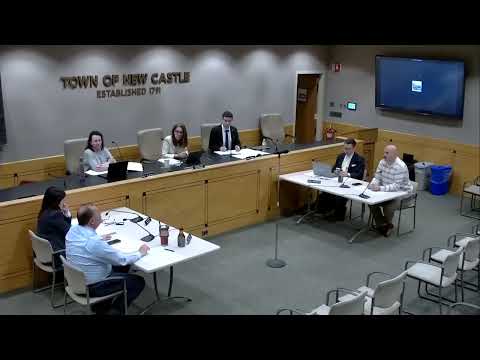
Public hearing on battery energy storage systems draws dozens of resident speakers; board keeps hearing open to April 28
Summary
Dozens of residents, local experts and the Conservation Board spoke at a public hearing on a draft local law that would allow residential (tier-one) batteries but prohibit tier-two and tier-three utility-scale battery energy storage systems in New Castle; the board voted to continue the hearing to April 28 to collect more comments and finalize definitions.
The Town of New Castle heard extended public comment Wednesday night on a proposed local law that would permit small, residential battery systems while largely prohibiting utility-scale battery energy storage systems (BESS). Staff and the board emphasized the draft was developed after consultation with fire/EMS professionals and that the New York State Building Code defines tier categories; the draft would allow tier-one residential systems by building permit but restrict tier-two and tier-three large-scale sitings.
Residents and experts spoke predominantly in opposition to large-scale siting in town. Sandra Stein, a resident, urged the board to adopt a ban on large-scale facilities and cited other nearby towns that recently enacted moratoria; she warned of thermal-runaway fires that “can sometimes take days to extinguish” and said large facilities raise risks of hazardous air emissions and contaminated firefighting runoff. Several neighbors repeated specific local concerns about a proposed facility referenced at 82 Shingle House Road; speakers said such a utility-scale facility would be incompatible with predominantly residential land use.
Technical and environmental testimony: Rose Pelino, a licensed environmental engineer and resident of Shingle House Road, outlined potential public-health and environmental pathways from a major battery fire, including airborne toxins and contamination from firefighting foam containing PFAS. The Conservation Board, represented by Brandon Kavanaaugh, supported encouraging residential (tier-one) battery adoption for resilience but recommended added town safeguards: soil and groundwater protections, end-of-life disposal rules, stormwater/impervious-surface review for outdoor installations, and closer scrutiny of wetland proximity and fire-suppression runoff.
Process and next steps: Staff told the board that tier definitions are consistent with state building code and that the town will incorporate those definitions into local code. Because two board members were absent, the board voted to continue the public hearing to April 28 to collect more public comments and produce a redline version of the draft for further review.
What was not decided: The hearing produced no final vote to adopt the law. Board members said they would take the written and verbal comments into account, incorporate missing definitions and present a redline draft to the board before any adoption vote.
Public quotes (selection): “I support the town's proposed ban on large-scale BESS,” said Sandra Stein, who cautioned that an incident could require evacuation of nearby homes and schools. Rose Pelino, a professional environmental engineer, told the board that “facilities of this nature belong in appropriately zoned industrial areas, not within residential neighborhoods.” Brandon Kavanaaugh of the Conservation Board urged the town to remove barriers to tier-one residential adoption while adding environmental safeguards.
The board will accept additional written comments and reconvene the hearing April 28.