Get Full Government Meeting Transcripts, Videos, & Alerts Forever!
Get email alerts on the Municipal Budgeting topic
No spam. Unsubscribe anytime.
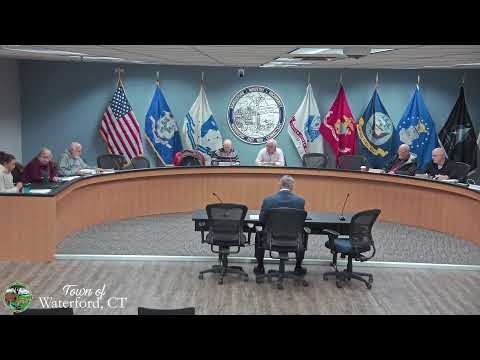
Board of Finance debates tax trajectory as it approves a series of department budgets
Summary
Board members questioned whether to set informal guidelines for mill-rate growth as department budgets were reviewed; the board approved multiple departmental budgets after presentations that highlighted revaluation work tied to Crystal Mall redevelopment and election preparations for 2026.
Waterford's Board of Finance spent significant time Monday night debating the town's likely mill-rate trajectory and whether the board should signal a target range to department heads as it approved a series of department budgets.
Michael, a board member, opened the substantive debate by noting last year's tax increase and projecting higher pressure this year: "We increased taxes 5%... and now we're looking at about 7%." He asked whether the board should give departments a guideline to aim for on annual increases. Jerry, another board member, pushed back on that approach, saying the board's role is to review budgets, not to set tax policy: "I don't think it's the purview of the board of finance to set tax policy. That's not our job." The exchange framed a larger discussion about preserving services while containing increases, with members repeatedly citing capital backlogs in roads and facilities as drivers of rising costs.
The meeting mixed forward-looking questions with routine budget reviews. Presenters highlighted operational and one-time needs that will affect future tax bills. The registrar of voters described ongoing training on recently introduced tabulators and plans to migrate the voter-registration system to "TotalVote," noting the launch date has shifted and that the state election later this year will include 14 days of early voting. "We continue to use paper ballots... we believe our elections are very safe," the registrar said in response to questions about security.
Assessor Paige told the board the assessor's proposed FY27 budget includes nearly a 10% increase driven by staffing requests, an expanded in-house personal-property audit program and preparations for a 2026 revaluation. Paige noted expected commercial activity at the Crystal Mall site and continuing valuation issues around the Millstone power plant, and described plans to use aerial imagery (Nearmap) and other tools to improve detection of new construction.
Votes at a glance - Registrar of Voters budget: approved (amount listed in the packet: $126,410). One member verbally recorded as opposing at the roll call. - Assessor: approved (amount listed in the packet: $351,260). - Board of Assessment Appeals: approved (amount listed: $5,693). - Tax Collector: approved (amount listed in the packet text: $233,69; transcript shows an incomplete figure). - Town Clerk: approved (amount listed: $271,688). - Representative Town Meeting (RTM): approved (amount listed in packet text: $17,82; transcript shows an incomplete figure). A separate motion to cut $400 for the RTM's Robert's Rules line item failed on a tie vote. - Board of Selectmen: approved (amount listed: $27,470).
Why it matters Board members framed the review as information gathering ahead of the board's final action. Several members warned that sustaining current services will keep upward pressure on mill rates; others emphasized the limits of the board's authority over tax policy and urged clearer comparisons with peer towns before drawing conclusions. The assessor's remarks about redevelopment at the Crystal Mall site (and the ongoing 2026 revaluation) were highlighted as potential drivers of changes to the grand list in the coming years.
What to watch next The board noted that the votes taken at these review meetings are preliminary; final budget approvals are scheduled at the board's public hearing and special meeting for budgetary action later in March. Board members asked staff for more comparative data on mill rates and for clearer cost analyses that illustrate which department budgets are elastic and which reflect unavoidable capital needs.
The meeting included public-facing clarifications and a range of procedural moves, but concluded with the board advancing the package of department budgets to the next step in the town's budget process.