Get Full Government Meeting Transcripts, Videos, & Alerts Forever!
Get email alerts on the Environmental Screening topic
No spam. Unsubscribe anytime.
Environmental Justice Council reviews Mass EnviroScreen and three‑year energy equity plan; residents press for clearer designation process
Summary
The Environmental Justice Council heard a presentation on the proposed Mass EnviroScreen cumulative‑impact tool and a three‑year Mass Save equity plan that presenters said would direct about $1.78 billion—roughly $1.2 billion to low‑ and moderate‑income customers—while community members urged clearer notification and follow‑up on petitions to restore EJ designations.
The Environmental Justice Council on Meeting 22 in Leominster heard a detailed briefing on a proposed statewide environmental‑screening tool and a linked energy‑equity plan, and took public comment from residents who said petition and designation processes need clearer, earlier notices.
Presenters from the council’s program team and contractors described Mass EnviroScreen as a composite screening tool that combines roughly 30 indicators—exposure, health, climate impacts and community vulnerability—into percentile scores to help identify communities facing the highest cumulative burdens. "The tools we are introducing today will be useful in completing the designation and restoration process," a council presenter said, describing the tool’s role in identifying locations for permitting and cumulative‑impact reviews.
The presentation also outlined a three‑year Mass Save plan (2025–2027) focused on equity and energy efficiency. Presenters said the plan would channel about $1.78 billion to support initiatives ensuring equitable outcomes, with roughly 40% of the three‑year budget aimed at designated priority communities and about $1.2 billion expected to support low‑ and moderate‑income customers. The plan includes home energy assessments, income‑eligible pathways, contractor support and a statewide multilingual customer service center to assist enrollment and technical questions.
Public commenters urged better communication of the formal petition process to restore an environmental‑justice designation. "We are very impatient and there has been no answer from the state," said Marian Babinski during public comment, describing a Westfield neighborhood’s experience after submitting signatures to request restoration of an EJ designation. Staff responded that the statutory petition process has not changed and that the new screening tool is intended to support and speed that process; they also committed to improving community notification and to sharing contact details and resources in chat and via email.
Council member questions during a brief Q&A focused on data transparency and funding timing. One member said the absolute counts (for example, the 69,000 households cited as potential beneficiaries) were helpful but asked for percentage breakdowns and disaggregated data for renters and other subgroups. Joan, a presenter and program lead, said quarterly reports and a dropdown filtering feature will be posted on the advisory website and gave an email for follow‑up; she added that the timing of some funds, including money tied to federal programs, depends on final approvals by the state energy office.
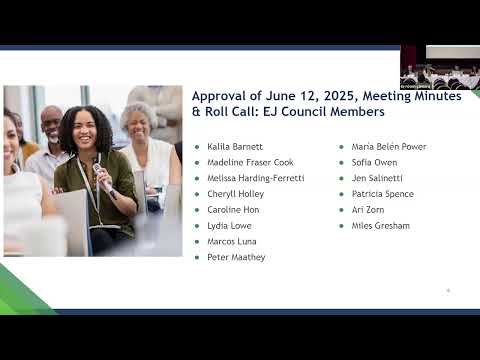
The council approved routine business before the presentations: the June minutes were approved (seven in favor, one abstention) and the August minutes were approved (six in favor, two abstentions). Staff announced a follow‑up online session on the screening tool scheduled for Nov. 6 and asked members to respond to a survey about the next meeting location; the council adjourned after a final roll call.
The council and presenters encouraged written comments and participation in upcoming sessions to refine the screening indicators and the equity plan. Materials, quarterly data and contact information will be posted on the council advisory site and distributed in the meeting chat.