Get Full Government Meeting Transcripts, Videos, & Alerts Forever!
Get email alerts on the Electric Service Connections topic
No spam. Unsubscribe anytime.
Utilities and state outline steps to streamline electric service connections in Massachusetts
Summary
National Grid, Eversource and the state described a shared 'Customer Connect' process on a webinar, emphasizing an early 'step zero' screening, new capacity maps, and timelines and costs for capacity studies to help municipalities and developers plan electric service connections.
Officials from National Grid, Eversource and the Executive Office of Energy and Environmental Affairs outlined a coordinated Customer Connect process for electric service connections during a statewide webinar. The session aimed to help municipal leaders, developers and contractors navigate the technical steps, approvals and potential costs involved in obtaining new or upgraded electric service.
"The purpose of this meeting is to share the process," Morgan Stacy, National Grid vice president of Connections and Strategic Accounts, said as she opened the session. State energy officials and utility representatives stressed early coordination between customers and utilities to avoid delays later in planning or construction.
Assistant Secretary of Energy Josh Ryer said the state is working with utilities and regional planners to standardize and streamline the process and that organizers will post a one-stop website with resources and links to utility portals. "We'll make sure that folks have access to a new one-stop website," Ryer said, describing the state's role in helping municipalities navigate the process.
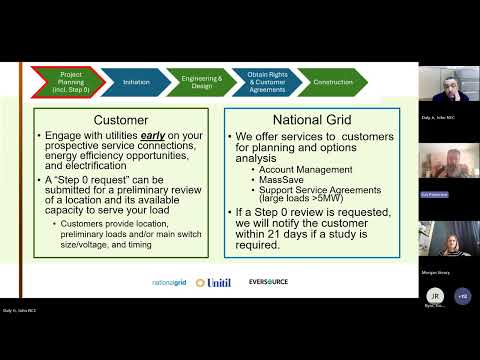
Both utilities emphasized a front-loaded step known as "step zero," in which a customer provides a location, preliminary load information and timing so the utility can determine whether a distribution or capacity study is needed. National Grid said a step-zero response typically takes about 21 days and helps customers determine whether to proceed to a full study.
Jim Patterson, who led National Grid’s presentation, described the five main stages utilities follow: project planning (step zero), initiation (application and work-order creation), engineering and design, pre-construction (rights, easements, inspections, customer payments) and construction/energization. Patterson highlighted that customers are often responsible for private-property trenching, tree trimming, municipal wiring inspections and any required easements or licenses.
When an attendee asked whether capacity studies have fixed costs, Patterson said timelines and costs vary by circumstance. "The typical cost is six months and $50,000, but it does depend on the circumstances in the area," he said, adding he has seen studies as low as $25,000 and as high as $75,000; he also said certain larger "second feeder" studies are about $75,000.
Eversource Director John Daley described a closely aligned process at his company and promoted a recently launched capacity map that lets users zoom to a property and view available capacity. "You can zoom in to any plot of land in Massachusetts that's in Eversource electric territory and you can see the available capacity," Daley said, and he recommended the map as the first planning tool for developers assessing site feasibility.
Both utilities said cost estimates provided during early screening are approximate (Eversource described estimates as plus-or-minus 25% and valid for 90 days) and that posted construction durations typically exclude time needed for municipal grant-of-location hearings, street-opening permits, customer payment of deposits, or easement acquisition. Patterson and Daley warned that municipal processes and permitting can add substantial time to the schedule.
Organizers said slides and a recording of the webinar will be posted on the EEA website and that follow-up seminars (including one on how to use Eversource's capacity map) are planned. The webinar drew more than 100 participants across the Commonwealth and concluded with organizers promising additional resources and continued coordination.