Get Full Government Meeting Transcripts, Videos, & Alerts Forever!
Get email alerts on the Energy Transmission topic
No spam. Unsubscribe anytime.
Residents press health, property and environmental concerns as Millstone zoning board continues hearing on JCPL corridor upgrades
Summary
At a continuation hearing on Jersey Central Power & Light Co.’s Clean Energy Corridor upgrades, the applicant described a minor design change and sought height and use variances while residents pressed health (EMF), property-value, tree removal, construction and well-aquifer concerns. The board carried the item to May 27 for additional materials and testimony.
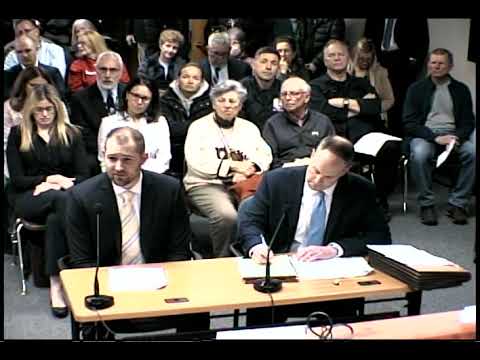
Jersey Central Power and Light Company (JCPL) returned to the Millstone Township Zoning Board for a continuation hearing on its Clean Energy Corridor project, telling the board it has reduced the local design slightly while residents urged the board to demand more project-specific data before approving variances.
Benjamin Nadell, counsel for the applicant, opened the presentation by recapping the project scope: replacement of lattice towers with new monopoles across roughly six miles of JCPL right-of-way in and near Millstone, with the company now proposing 39 new structures and 44 poles — a small reduction from figures given earlier in the review record. Nadell said the proposed monopoles would range in height roughly from the low 60s to nearly 200 feet and that JCPL is seeking D1, D3 and D6 variances plus preliminary and final major site plan approval.
Why it matters: the project would raise some poles and introduce new monopoles closer to a number of private homes and accessory structures, and the board must weigh utility reliability and regional transmission benefits against neighborhood impacts including visual change, tree removal, construction disturbance and community concerns about EMF exposure.
Project presentation and timing Gregory Brown, the project design engineer, described the single substantive design change since the prior hearing: in a constrained corridor segment JCPL determined it could replace two proposed steel poles with lower wooden poles (corrected in testimony to roughly 63 feet above ground) so as not to disturb adjacent existing structures. Brown and other witnesses emphasized all work would stay within JCPL’s existing easement.
Jeffrey Morris, the applicant’s site civil engineer, ran through comments from the township’s engineering review letter and described phasing: access mats and temporary roads to mobilize crews, demolition of lattice towers, drilling and pouring cylindrical foundations with steel reinforcement, erection of monopoles and final wiring and restoration. Morris estimated mobilization for Milstone work could begin in mid-summer 2027 and that Milstone construction would likely be completed in a rolling approach over about 18 months, with roughly six months per section depending on contract sequencing.
Board questions focused on conductor configuration, right-of-way widths (about 180 feet), conductor blowout/swing, clearances required by code, and why some replacement poles are much taller than the existing structures. Brown and Morris explained that a mix of circuit voltages (the project combines existing 230 kV facilities with new 500 kV circuits in some spans), terrain, span lengths and code-required clearances drive some of the taller structure heights; they said designers generally keep new structures “like for like” where feasible to minimize span and visual disturbance.
Proximity to homes, foundations and construction impacts Morris reported the project team’s survey work identified six dwellings within 200 feet of proposed structures and listed several lots with distances between roughly 102 and 153 feet; he testified distances were measured from the pole center to the nearest building footprint. The board and residents pressed for clearer site plans and aerial exhibits showing house locations, and for parcel-by-parcel detail the board can use to judge fall‑zone, shading and visual impacts.
On foundation design, Morris said monopole foundations would vary with soils but typically would be 30–40 feet deep and 7–10 feet in diameter; the applicant said soils removed during drilling would be stockpiled, tested and hauled to approved facilities. Morris acknowledged contractor staging, access and potential roadway damage are real issues and said JCPL would document pre-construction conditions and be liable for repair of construction-related damage through typical performance bond mechanisms.
EMF testimony and public concerns Pamela Dopart, an EMF subject-matter expert with Exponent, testified about how electric and magnetic fields behave: field levels fall quickly with distance from the source and vary by configuration and current loading. She summarized major agency reviews (World Health Organization, IARC and U.S. research bodies) and said none of those agencies has concluded that community-level EMF exposures from transmission lines have established adverse health effects. She also said New Jersey has an electric-field standard measured at the right-of-way edge (3 kilovolts per meter) and that project-specific modeling or field measurements are the right way to quantify exposure at particular homes.
Residents pushed back. Several people who live in the easement corridor said they had measured milligauss levels on their property, cited independent studies they believe show elevated cancer risks near high-voltage lines, and asked for property-by-property EMF modeling before the board considers variances. Pamela Dopart said she had not provided project‑specific milligauss maps at the hearing and recommended that the utility produce the modeling or measurements that would answer those local questions.
Environmental, trees, wildlife and alternatives Residents and some board members pressed environmental concerns: Morris acknowledged wetlands are present in some easement areas and the applicant intends to request waivers from the township’s conservation-easement requirements because JCPL does not own the underlying fee-simple properties. The environmental witness (Amy Jones) had been scheduled but did not complete testimony before the meeting ended; the board deferred detailed questions about tree removal counts (the applicant referenced tree clearing numbers that the environmental witness will document) and avian impacts, including an assertion from a resident that a raptor nest is associated with an existing tower.
Undergrounding and benefits debate Several residents asked why the upgrades could not be placed underground through the easement corridor. Applicant witnesses and counsel responded that underground transmission cable installation typically carries very large cost premiums (engineers and counsel estimated multiple times the overhead cost), requires long continuous trenches and different permitting and long-term repair constraints, and would not necessarily eliminate all environmental disturbance during construction; they also said undergrounding can complicate future repairs. The applicant reiterated that the primary stated public benefit is transmission-level resilience and regional reliability: transmission improvements support the broader grid that, when it fails, can produce larger outages than distribution failures alone.
What the board asked for and next steps During questioning the board requested additional exhibits and clarifications before accepting final testimony: parcel-specific distances and aerials, the noise analysis and sound-related data the applicant referenced, a tree-clearing and wetland impact accounting from the environmental witness, site-specific EMF modeling or measurement plans, construction access/staging details, and clarifications on conservation-easement waiver authority.
Chair’s announcement and procedural outcome The board carried the application to a continued session on May 27 at 7:30 p.m. in the municipal chambers so the applicant can produce the requested materials and the remaining witnesses (environmental and planner) can complete testimony. No formal vote on the variances or approvals was taken at tonight’s session.
Quotes that illustrate the hearing “Good evening. For the record, Benjamin Nadell, I am a partner with the law firm Saul Ewing… appearing this evening on behalf of the applicant Jersey Central Power and Light Company,” Nadell said as the applicant recapped the project for the board.
“EMF stands for electric and magnetic fields… as you move further away from that source, the levels are going to drop very quickly,” Pamela Dopart testified, describing how exposures change with distance and noting that authoritative agencies have not concluded community exposures cause adverse health effects.
Resident concerns were pointed. “I will not sign over an easement to you,” one nearby homeowner said, asking for parcel-level EMF modeling and for the applicant to pay for that work.
What’s next The board left the record open and scheduled the continuation for May 27, when the applicant will be expected to provide the requested parcel‑level exhibits, the environmental witness’s tree/ wetlands analysis, the noise documentation the team referenced, and EMF modeling or a plan for measurement at affected properties. The board indicated it will accept or reject testimony and exhibits at that hearing before moving toward any final vote.