Get Full Government Meeting Transcripts, Videos, & Alerts Forever!
Get email alerts on the Zoning Data Centers topic
No spam. Unsubscribe anytime.
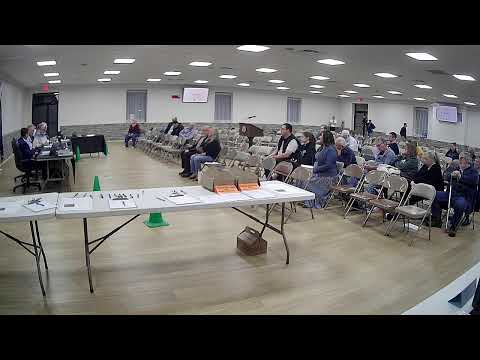
East Manchester supervisors adopt data-center overlay and rules after heated hearing
Summary
East Manchester supervisors closed a public hearing and voted to adopt two interrelated ordinances (2026-2 and 2026-3) creating a data-center overlay district and a new chapter of township code regulating data-center development; the move followed extensive resident opposition on impacts including noise, water, property values and process fairness.
East Manchester Township supervisors closed a public hearing and approved two ordinances to create a data-center overlay and set detailed development and operating standards for data centers in the township.
The board adopted Ordinance 2026-2, a zoning amendment establishing the overlay district and dimensional rules, and Ordinance 2026-3, a new chapter of township code (Chapter 83) that sets site, landscaping, sound, water-study and decommissioning requirements. The board also directed the solicitor to publish a notice of municipal action under Section 108 of the Pennsylvania Municipalities Planning Code, opening a statutory period for procedural challenges.
Why this matters: Residents repeatedly told the board they fear long-term changes to community character, possible impacts on wells and wildlife, continuous noise and lighting, and declines in property values if data centers are permitted in or near residential and agricultural areas. The board and its solicitor said the ordinances were written to constrain development where possible while avoiding legal standards the Pennsylvania Supreme Court has found can render local ordinances unconstitutional if they effectively exclude a legitimate land use.
Resident concerns and examples "My biggest concern with this is infrastructure," said John, a township resident, arguing that data centers "can use as much electricity as an entire neighborhood" and produce continual noise and light. He and others questioned whether the projected tax or economic benefits justify potential disruptions and noted that data centers typically employ relatively few people after construction.
Several residents raised water and well concerns, asking what studies and safeguards will prevent a data center from depleting or contaminating ground water or increasing stormwater discharge. Debbie Palmer asked what would happen "when my well goes dry," and whether residents would be able to prove a link to a new facility.
Process and trust issues Multiple commenters — including Daniel Loyc, who said his last name was spelled L-O-Y-C — accused the process of moving too quickly and suggested the zoning changes had been steered by property-owner requests. The board rejected suggestions that it was acting as a developer proxy and said staff and the solicitor had considered public comments and made revisions where feasible.
Legal limits and ordinance features Township Solicitor (unnamed) told the hearing the board is constrained by Pennsylvania law and a recent Pennsylvania Supreme Court decision cited in the hearing. "A zoning ordinance that excludes a legitimate use of land may be found unconstitutionally exclusionary," he said, summarizing the legal limit on blanket denials.
To balance legal risk with resident protections, the ordinances include: a 25-acre minimum lot size per data-center building (the ordinance text clarifies that a 35-acre parcel can host one building and a 105-acre parcel four buildings); a 50-foot vegetative buffer with clarified planting-density rules and staggered trees/shrub mixes providing a 12-foot-high screen within three years; required pre-, during- and post-construction sound studies; extensive water-use and environmental-impact studies (including review by the Susquehanna River Basin Commission where applicable); a 500-foot setback from residential districts along the overlay; a maximum structure height of 55 feet in agricultural areas; and a decommissioning escrow equal to 110% of estimated removal costs.
Board action and next steps After public comment and board discussion the supervisors moved to close the hearing and then to adopt Ordinances 2026-2 and 2026-3. The transcript records the motions, seconds, and that the board carried the votes and directed publication of a municipal action notice under Section 108 of the Municipalities Planning Code to provide notice and an opportunity to challenge procedural defects. The solicitor will publish the notice as required; that publication starts the statutory period for any procedural challenges.
What remains unresolved Residents urged more specificity on monitoring and enforcement capacity, emergency generator operation limits, and mechanisms to address well impacts attributed to development. The ordinances require studies and post-construction monitoring, but residents expressed skepticism that township staffing and enforcement resources will suffice. The board said it will continue to review and may refine the ordinances as more information or state guidance becomes available.
Votes at a glance - Ordinance 2026-2 (zoning overlay and dimensional standards): motion adopted; vote recorded in the hearing transcript as "That vote is 3-0." (tally per transcript) - Ordinance 2026-3 (new Chapter 83, data-center regulations): motion adopted; board carried the motion and directed publication under Section 108.
The supervisors adjourned after taking the votes. Publication of the municipal-action notice will provide the formal procedural record and begin the statutory period for any challenges.