Get Full Government Meeting Transcripts, Videos, & Alerts Forever!
Get email alerts on the Ai Disclosure topic
No spam. Unsubscribe anytime.
FPPC debates AI disclosure rules for campaign ads, weighing deepfake safeguards against broad warnings
Summary
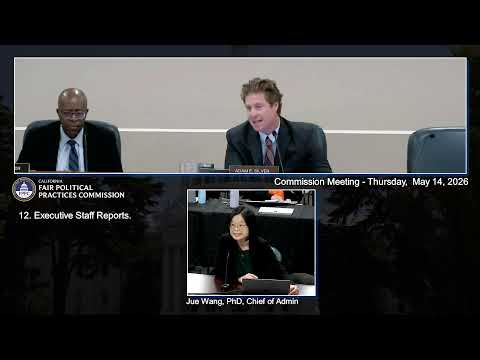
At its May 14 meeting the Fair Political Practices Commission discussed proposed regulation 18450.12 on artificial-intelligence disclosure and related recordkeeping changes. Commissioners and staff debated when a disclosure is required, how to define “authentic” and the enforcement and recordkeeping burden; staff will seek stakeholder input and return in August.
Senior commission counsel Zachary Norton presented proposed regulation 18450.12 and amendments to regulation 18401, explaining how Government Code section 84514 (effective 2025) creates a two-step inquiry for campaign-ad disclosures when AI is involved. "If AI has not been used in any way to create the advertisement, this doesn't apply and there's no analysis," Norton said, describing the threshold step and the two statutory prongs that trigger disclosures.
Commissioners pressed staff on the scope and meaning of the two prongs: an ad "entirely created using AI" that "would falsely appear to a reasonable person to be authentic," and ads "substantially altered" by AI that would cause a "fundamentally different understanding" of the content. Commissioner Brandt said he wanted a clearer line between minor edits and deceptive deepfakes, noting that routine image retouching should not automatically trigger disclosure.
Several commissioners warned against creating a disclosure regime so broad that the notice loses meaning. Commissioner Ortiz said the commission should avoid a result where AI disclosures appear on virtually every ad and "become almost like the Prop 65 disclosure that you see everywhere." Commissioner Wilson and others asked staff to consider how the rules would operate on social media and whether enforcement capacity is sufficient during an election season.
Staff walked the commission through hypotheticals—mailers that use AI to change backgrounds, fully AI-generated images, and AI-augmented video ads. Norton described the proposed regulatory language that would treat a materially altered ad as triggering disclosure when it "depicts an individual saying or doing something the individual did not say or do or contains a realistic depiction of something that did not occur." Several commissioners supported that approach as a practical way to anchor "substantially altered" to observable circumstances.
Legal staff and commissioners also discussed recordkeeping amendments to require original materials for AI-generated ad creation and the practical need for an enforcement process that can evaluate complaints, including forensic and documentary steps. Commissioners directed staff to solicit public and industry feedback, hold a focused stakeholder session before August, and return with revised language for possible adoption at the August meeting.
The commission did not adopt regulations at this session; staff emphasized they will post examples and materials on the FPPC website and recommended outreach to regulated entities and campaign consultants to refine definitions and enforcement procedures ahead of the August meeting.