Get Full Government Meeting Transcripts, Videos, & Alerts Forever!
Get email alerts on the Rent Stabilization topic
No spam. Unsubscribe anytime.
Rent stabilization analyst explains anti‑retaliation, harassment protections for Mountain View tenants
Summary
At an evening community presentation, Danaya Thomas of the Rent Stabilization Division explained which apartments and mobile homes are covered by the CSFRA and MHRSO, outlined examples of prohibited landlord retaliation and harassment, and described how tenants may file a report and access city resources.
Danaya Thomas, an analyst with the Rent Stabilization Division, told attendees at a community presentation that the City’s anti‑retaliation and anti‑harassment rules protect tenants who exercise their legal rights, such as requesting repairs or disputing rent. "This addresses real concerns about landlord retaliation and harassment when tenants exercise their legal rights," Thomas said.
Thomas explained who is covered under the local rent‑stabilization rules: she said most apartments built before Dec. 23, 2016 are covered by the CSFRA; she described "fully covered" units as those built before 1995 that are not government or subsidized rental units and described "partially covered" units as those built between 1995 and 2017 that are not government or subsidized units. She also said the MHRSO, effective Oct. 28, 2021, covers mobile‑home owners who lease a pad and mobile‑home renters occupying space in a mobile‑home park, including communal facilities and housing services provided by a park owner.
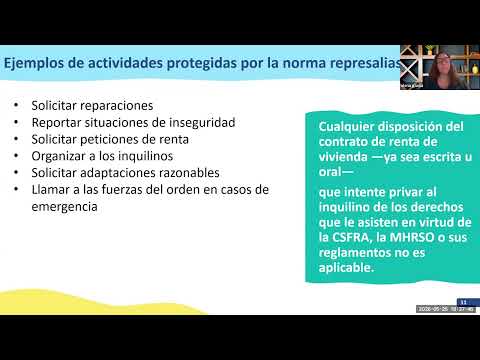
Thomas defined retaliation as a landlord taking adverse actions in response to a tenant asserting specific rights, and harassment as bad‑faith conduct—such as threats, coercion, fraud or intimidation—intended to prevent a tenant from exercising or asserting rights. She provided examples of protected tenant activities: requesting repairs, reporting unsafe conditions, filing rent petitions, organizing tenants, requesting reasonable accommodations and calling law enforcement in emergencies.
She listed examples of harassment to watch for: unnecessary late‑night repairs, threats of eviction without legal cause, coercion to force a tenant to vacate, verbal or written threats without legal justification, withholding or failure to provide housing services, removal of tenant property and refusal to accept or acknowledge lawful rent payments. Thomas cautioned that communicating with a tenant in a language other than the tenant’s primary language to intimidate or confuse them can also constitute harassment.
On responsibilities, Thomas said landlords must maintain habitability—timely repairs and essential services—issue lawful notices and train staff on compliance. Tenants should document communications, keep written records of repair requests and rent payments, follow lease terms and report violations to the Rent Stabilization Division.
Thomas described the city’s harassment/retaliation report process: tenants complete the city’s report form, send a copy to the landlord and provide the form to the city; tenants also submit a landlord response form. She emphasized that "filing a report with the city does not constitute a determination or finding by the division, the committee or the city on the validity of the complaint," and that filing does not necessarily mean the city will take enforcement action. She added that harassment or retaliation claims may be brought in court and may not always be resolved through the city’s petition process.
Thomas said protections under the CSFRA and MHRSO should be considered by courts when evaluating claims and that a landlord’s failure to comply with those protections can be raised as a defense in eviction proceedings.
For help, Thomas listed Rent Stabilization Division contact information and services: phone (650) 903‑6136, the division’s email at mvrent@mountainview.gov, weekly virtual office hours Tuesdays from 10 a.m. to noon, landlord help centers Thursdays from 1 p.m. to 3 p.m. (virtual and in person), tenant help hours the first and third Thursday of each month from 6 p.m. to 8 p.m., workshops on Zoom and an in‑person resource location at 298 Escuela Avenue in Mountain View. She directed attendees to the city website for webinar links and closed the session.
The presentation provided practical guidance on identifying retaliation or harassment and on the forms and documentation tenants should gather if they pursue a report or legal action. Thomas closed by encouraging attendees to use the city’s resources and workshops for additional assistance.