Get Full Government Meeting Transcripts, Videos, & Alerts Forever!
Get email alerts on the Economy topic
No spam. Unsubscribe anytime.
Dan Macintosh: Oil‑price surge could boost county revenues but tight labor and housing constrain growth
Summary
Dan Macintosh presented a revised annual trends report saying Laramie County is "operationally sound" but has limited surge capacity; higher oil prices and record taxable sales may lift revenues short term while housing shortages and a near‑3% unemployment rate limit sustained local growth.
Dan Macintosh, director of the Wyoming Center for Business and Economic Analysis at Laramie County Community College, told a Cheyenne Technology Advisory Council fireside chat that Laramie County’s economy is "operationally sound" but has "limited surge capacity," and that a recent jump in oil prices could boost state and county revenues in the short term.
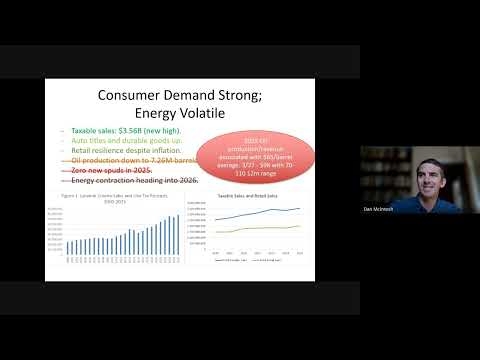
Macintosh said the center’s revised annual trends report (published in March, covering 2025 data) showed taxable sales hit a new high of $3.56 billion, adjusted for seasonal factors, driven in part by increased activity at data centers and higher vehicle purchases. "People are happy to be spending money right now," he said, linking stronger compensation and consumer confidence to higher sales.
The presentation flagged a sharp shift in energy markets: at publication the report used about $65 per barrel for oil, but Macintosh said prices traded near $98 per barrel later and that a 12‑month forecast range could span roughly $70 to $110 depending on geopolitical developments in the Middle East. He noted the center had observed an unprecedented drop in new drilling starts (spuds) to near zero at the time of publication, a historical warning signal that was overtaken by the later price rise.
Macintosh cautioned that oil production typically responds to price changes with a lag—about two quarters in his analysis—and that large price deltas drive the most pronounced production increases. "If the expectation is 65 to 66 we're not going to see much of that sensitivity but if there's a significant jump like what we saw in 2022, that's where the production really cranks up," he said.
Even with stronger revenue signals, Macintosh warned that local constraints would limit how much the county benefits. He described employment as "very strong" with unemployment around 2.9–3 percent, leaving little labor slack; firms expanding in higher‑skill sectors are paying premiums to recruit workers. He also described commuting patterns that reduce local spending: roughly 9,000 people commute out of the county while about 10,000 commute in, and Macintosh said incoming commuters tend to earn more and take earnings to other counties rather than spending them in Laramie County.
On the tech sector, the presentation noted growth in information and technology jobs that pay well and tend to be less volatile than construction. But panelists warned that Wyoming faces physical constraints—power and water capacity for data centers—and that relying heavily on any single sector risks recreating boom‑and‑bust dynamics.
Macintosh closed by urging policymakers to focus on durable, human‑capital investments. When asked what he would tell the governor and legislators, he recommended prioritizing K‑12 and higher education funding to retain and develop local talent, saying the state has historically done best when it sustained investment in education.
The fireside chat ended with a brief wrap‑up and thanks; the session experienced intermittent internet connectivity during the presentation.