Get Full Government Meeting Transcripts, Videos, & Alerts Forever!
Get email alerts on the Boards And Commissions Governance topic
No spam. Unsubscribe anytime.
Council Appointments Committee keeps professional-designation preferences optional, endorses mandatory background checks for police review board
Summary
At its April 17 meeting the Council Boards and Commissions Appointments Committee voted to recommend that professional designations for Planning Commission seats remain preferences rather than requirements and endorsed making criminal-background checks mandatory for Community Police Review Board applicants; staff will draft an ordinance for council action in June.
The Council Boards and Commissions Appointments Committee on April 17 edged away from strict professional requirements for several advisory bodies and endorsed mandatory criminal-background screening for police oversight volunteers, while pausing a proposal to disband the municipal judge compensation commission.
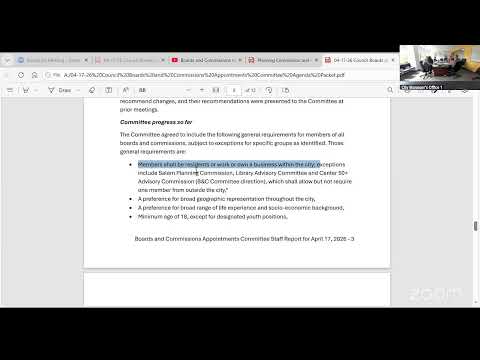
Chair Deanna Gwyn called the meeting to order and staff walked the committee through a yearlong governance project that would standardize bylaws, annual reporting, naming conventions and a council-liaison framework for boards and commissions. Staff told the committee that, under the recommended changes, members would generally need to be residents or work in the city, be at least 18 (except designated youth positions), be limited to serving on no more than two boards at once, and pass criminal background checks similar to city volunteer screening.
"All members of boards and commissions will need to pass a criminal background check in the same process that city volunteers do," staff said, a procedural change the committee endorsed for the Community Police Review Board (CPRB). Staff also said they and the Police Department developed a set of mandatory disqualifying criteria that the committee approved to apply to CPRB candidates; the committee agreed that holding a seat for a victim of a felony crime should remain a preference rather than an absolute requirement.
The panel spent significant time on the Planning Commission's request to identify one environmental professional, one transportation or engineering professional, and one architect or design professional for membership. After discussion about recruitment challenges and the breadth of useful backgrounds, Councilmember Shari Matthews moved that those specific professions not be required; the motion was seconded and carried by voice vote.
"I will make the motion that we move to not recommend these individual professions be requirements of the planning commission and instead move with our normal goals of having a diverse talent base," Matthews said during the vote.
Committee members debated alternatives including wording such as "experience in the field" or "professional background" to avoid excluding retired or differently qualified residents. Staff noted the Planning Commission itself had recommended the preferred specialties but did not ask that they be mandatory.
On the municipal judge compensation commission, staff recommended disbanding the three‑member body because of long-running recruitment problems. Judge Elna Beaty raised concerns about using the compensation commission to adjudicate judicial misconduct; after discussion the committee agreed by consensus to pause the disbanding recommendation while staff and council develop a more considered approach to judicial oversight.
The Public Art Commission recommended loosening specialty-seat requirements (reducing rigid specialty quotas and adding at-large positions) to ease recruitment. Committee members discussed whether public-art commissioners should be Salem residents or simply work in Salem or fall within the urban growth boundary; a motion to limit membership strictly to residents failed, and the committee indicated the baseline code requirement—members must be a resident or work or have a business in Salem—will apply unless council directs otherwise.
Staff said they will draft an ordinance that incorporates the committee's recommendations and return it to council for consideration, with a target of bringing the ordinance forward in June. The committee adjourned after completing its review.
Votes at a glance: - Motion to approve prior meeting minutes: motion made and seconded by Julie Hoy; voice vote recorded and motion passed. - Motion to keep Planning Commission professional slots as non‑requirements (preferences instead): mover Councilmember Shari Matthews; second Gwen I.; motion carried by voice vote. - Recommendation to disband the municipal judge compensation commission: committee paused the recommendation by consensus pending further staff work; no formal disbanding vote taken.
Why it matters: The committee's recommendations will shape who is eligible to serve on Salem boards and commissions and how recruitment and oversight function. Making background checks mandatory for the CPRB affects who can be appointed to a body that reviews police conduct; shifting professional designations from "required" to "preferred" changes the criteria used to evaluate applicants for the Planning Commission and may broaden the applicant pool.
Next steps: Staff will draft an ordinance reflecting the committee's recommendations for council consideration, expected in June. The committee adjourned with no further action taken at this meeting.