Get Full Government Meeting Transcripts, Videos, & Alerts Forever!
Get email alerts on the Municipal Impact Fees topic
No spam. Unsubscribe anytime.
Workshop reviews proposed impact fee increases and staff'recommends "extraordinary circumstances" for faster implementation
Summary
City staff presented a municipal impact fee study proposing higher residential impact fees for police, fire and parks (and a reduced library fee), explained statutory limits and cited rapid population and visitor growth and rising construction costs as justification for pursuing the statute's "extraordinary circumstances" path; no vote was taken at the workshop.
City officials heard a presentation on a municipal impact fee study that would raise several development fees meant to pay for growth-related capital costs for police, fire, parks and libraries.
"These are fees that are paid specifically by new growth and development," said Sean Oasio, identified in the workshop as a senior manager with Reptile House Financial Consultants, as he explained the study's purpose and methodology. Oasio told the council the study uses a design period through 2030 and combines permanent and visiting populations to calculate service demand.
The study proposes a number of changes. For police, the residential impact fee would rise from $144 to $194 per dwelling unit; the police nonresidential fee (now $880 per 1,000 square feet) would be reweighted by land-use types (retail/food, office, hotel per room, institutional, and industrial/warehouse). For fire, the residential fee would rise from $249 to $292 per dwelling unit and new nonresidential per-1,000-square-foot rates were proposed. Parks and recreation residential fees were proposed to increase from $867 to $1,258 per dwelling unit, while library fees were calculated to fall from $72 to $62 per dwelling unit because growth has diluted per-unit costs.
Oasio emphasized legal constraints on how fees may be used: "you cannot use these fees to meet any sort of operating deficiencies," he said, and repeated that fees cannot be used to pay officer salaries. He explained impact fees may be used for growth-related capital costs and related debt but not for ongoing operating costs.
The consultant outlined two implementation options. The standard method would phase increases in line with statutory limits that cap single increases at 50% and require multi-year phase-ins for increases of certain sizes. The staff-recommended alternative is to pursue the Florida statute's "extraordinary circumstances" process so the city could implement larger or faster increases in a single adjustment. Oasio said the extraordinary-circumstance path requires two public workshop meetings as part of the procedural record and, currently, a two-thirds governing-body vote to adopt; he noted that Senate Bill 1080, effective January 2026, will permit exceeding the 50% cap only if phased and will raise the adoption threshold to a unanimous vote and bar extraordinary-circumstance use if fees have not been updated in more than five years.
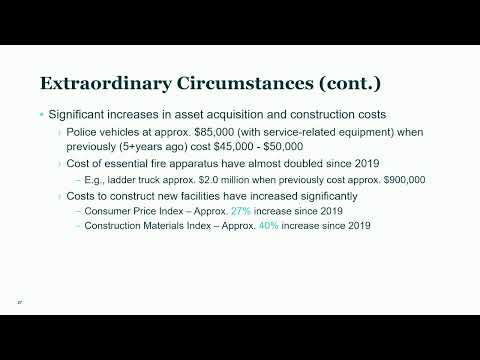
As justification for extraordinary circumstances, Oasio pointed to rapid growth and rising costs: he said permanent population grew by nearly 9,000 residents since 2010 (an average of roughly 3.8% per year) and that peak-day visiting population had increased from about 30,000 to about 55,000. He also cited material increases in construction and equipment costs, including higher vehicle and truck prices and a 40% jump in a construction materials index since 2019.
The presentation included detailed asset and project accounting used to compute fees: police capital on the books of roughly $12.6 million (with about $5.3 million in vehicle-related costs and roughly $6.1 million in major facilities included), planned police capital of about $11 million (netted to exclude grants and replacements), and a per-officer capital allocation the consultant estimated at just under $135,000 based on the study's design window. Fire and parks figures were presented with similar inclusions and exclusions for grant-funded and replacement projects.
Council members asked clarifying questions during the workshop but took no formal action. Mr. Davis clarified that this session was a required workshop and not the public hearing or adoption vote: the public hearing and any adoption would occur at the ordinance's second reading during the regular meeting at 5:00 p.m., and no action may be taken here.
The consultant recommended the council adopt the proposed fee schedule and pursue the extraordinary-circumstance procedural path, and reminded the council to maintain compliance with statutory timing requirements (update every four years and observe a 90-day delay between adoption and collection). The workshop concluded with agreement to continue discussion and public comment at the regular meeting when the ordinance comes up for second reading; no vote was taken during the workshop.