Get Full Government Meeting Transcripts, Videos, & Alerts Forever!
Get email alerts on the Rezoning topic
No spam. Unsubscribe anytime.
Palmetto Bay council rezones 8917 SW 158th Street to R1, grants lot-width variance with privacy hedge after neighbor objections
Summary
The Village Council approved rezoning 8917 SW 158th Street from agricultural to single-family R1 and granted a lot-width variance (66 ft permitted where 75 ft is required), conditioned on a recorded restrictive covenant and a 7-foot hedge to address neighbor privacy concerns. The decision passed 4-0 after public testimony.
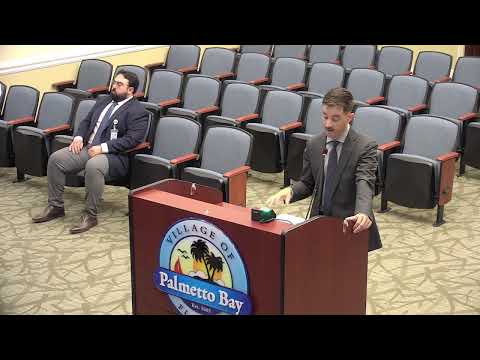
The Village of Palmetto Bay on March 16 approved rezoning 8917 Southwest 158th Street from agricultural to single-family residential (R1) and granted a companion lot-width variance, after neighbors raised concerns about neighborhood character and privacy.
Planning staff and the applicant said the 66-foot parcel is legally nonconforming and that R1 zoning would align the lot with surrounding single-family development and relax agricultural setback constraints that make building difficult. "Staff supports the approval of the ordinance rezoning the property from agricultural to R1," Principal Planner Edgar Madero told the council during his presentation. The council had previously recommended approval at the Local Planning Agency meeting.
Neighbors argued the parcel is narrow compared with nearby lots, warned that approval could set a precedent for altering block character, and described outreach contacts from staff they found unsettling. "Approving this may change the established pattern of the block," said resident Alan Pigot, who urged the council to apply the variance criteria carefully. Gabriella Galvanion and Alvar Ton, adjacent-property residents, expressed similar privacy and character concerns.
Applicant George Casali said he intends to build a single-story family home compatible with the neighborhood and that the lot’s size (roughly 16,000 square feet) and the agricultural designation make development difficult under current setbacks. Staff and the applicant documented historical platting and a 2000 warranty deed showing the parcel's legal history; staff concluded the request meets most rezoning criteria and recommended approval.
Because the zoning hearing was quasi-judicial, the village attorney reminded council members that any decision must rest on "competent, substantial evidence." Staff recommended a condition requiring the applicant to record restrictive covenants limiting the parcel to a single-family dwelling and prohibiting further subdivision. After a brief recess to confer with the applicant, Casali agreed to add a 7-foot hedge along the eastern property line to address privacy concerns. The council approved the rezoning ordinance and the associated variance, as amended, by unanimous roll call vote (Mayor Karen Cunningham, Vice Mayor Mark Meritzer, Council Members Steve Cody and Marshia Matson voted yes).
The variance decision included a recorded covenant condition and the 7-foot hedge requirement before issuance of building permits; the council also noted that density on the parcel will remain limited to one dwelling regardless of zoning. The applicant and staff said the change does not add density but allows a home design that fits the neighborhood’s pattern. The council took no further action on building design at this hearing; the applicant will pursue permits consistent with the approved zoning and the recorded conditions.
The council’s action resolves the immediate permit constraint for the property at 8917 SW 158th Street. Neighbors who spoke at the hearing said they remain concerned about precedent and the process; the council and village attorney reiterated that quasi-judicial findings must be fact-based in the record.