Get Full Government Meeting Transcripts, Videos, & Alerts Forever!
Get email alerts on the Flood Control Budget topic
No spam. Unsubscribe anytime.
Cochise County supervisors review Flood Control District budget, agree to soil testing and cleanup of Knable property
Summary
In a May 28 work session, Cochise County supervisors heard a Flood Control District budget presentation outlining $4.89 million in cash carryforward, roughly $2.63 million in property-tax revenue and about $8 million in planned expenses, and agreed without a formal vote to proceed with phase-2 soil testing and cleanup of a county-owned property being evaluated for recharge.
Cochise County supervisors met May 28 in a Flood Control District work session to review district revenues and planned projects and to authorize staff to proceed with soil testing and cleanup of a county property being evaluated for recharge.
Flood control staff told the board the district expects $2,630,000 in property-tax revenue, an interfund transfer of $740,975, a Watersheds grant of $41,436 and a cash carryforward of $4,890,000. "The real property of 2,630,000, this is the property taxes received for the flood control district," Flood control staff (S3) said while presenting the revenue slide. Staff listed project allocations including $550,000 for Horseshoe Draw erosion repairs, $70,600 for a "3 Canyons" recharge design and well repairs, $125,000 for USGS stream monitoring, and $210,000 for a Riverstone recharge design that is under discussion with the City of Sierra Vista.
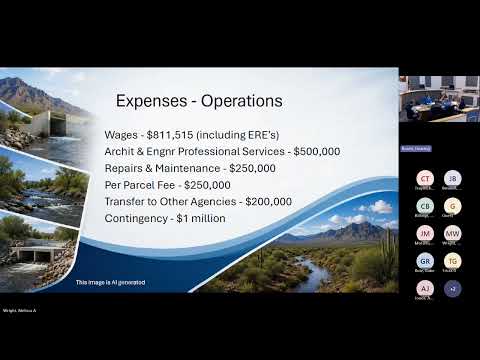
On operating costs, staff presented a wages line of $811,000 (including EREs) and said the funded positions amount to roughly four full-time staff plus part-time and split positions, approximately five FTEs when combined. Staff also listed $500,000 for architectural and engineering services, $250,000 for repair and maintenance, a treasurer collection fee roughly $250,000 tied to parcel billing, and a contingency of $1,000,000. After adding project and operations spending, staff reported total planned expenses of about $8,000,000.
Chair (S1) raised the idea of setting the district's rate to zero for one year and operating off the cash carryforward to avoid a tax increase tied to rising valuations. "If we lower the rate, which offsets the increase in valuation," the Chair said, but staff cautioned that using carryforward to cover recurring needs or to defer the levy could exhaust contingency and undermine the ability to meet grant-match commitments or to fund large construction projects. Flood control staff pointed to Coyote Wash as an example of a potential $5,000,000 construction cost that could eliminate contingency funds.
The board discussed a county-owned property identified in the presentation (referred to in the meeting as the Kenebel/Knable property). Flood control staff explained that about $250,000 remains from a prior project and that the next step is phase-2 soil testing to check for petroleum contamination and other hazardous materials; any unused funds could be applied to cleanup (removal of old vehicles, tires and debris). "We actually have some money that we can tap into from the [prior] project. There's $250,000 that's left over ... and it looks like we can use that money for the cleanup process so that we can get the vehicles out of there," Flood control staff said. Supervisors and staff agreed there were no objections to moving forward with testing and cleanup; staff said they would proceed and report back to the board.
Supervisors also opened the discussion on community concerns tied to recharge and reuse, including questions about effluent, PFAS and whether treated water would meet regulatory standards. Staff and other supervisors repeatedly emphasized that soil and site testing will determine whether recharge is feasible and safe. As one staff member (S4) summarized residents' concerns: PFAS was a major issue and several residents said they would accept reuse "if the quality was to the EPA standard." Staff confirmed the City of Sierra Vista's contractor had carried out soils testing and that the board is awaiting results to determine feasibility.
No formal motions or recorded votes were taken on the budget or levy during the work session. The board signaled support for proceeding with the Knable property testing and cleanup and directed staff to provide additional detail, public notice and future reporting. The meeting was recessed for 15 minutes and is scheduled to reconvene at 2:00 p.m. for a Public Works update.
Next steps: staff will initiate phase-2 testing on the Knable property, notify the public about the cleanup steps, and return findings and budget recommendations to the board for any required formal action.