Get Full Government Meeting Transcripts, Videos, & Alerts Forever!
Get email alerts on the Zoning And Housing topic
No spam. Unsubscribe anytime.
Planning commission recommends city council adopt zoning, SP‑5 and objective‑design updates tied to housing element
Summary
The commission unanimously in substance (vote 5–2) recommended that city council adopt zoning code and Specific Plan 5 updates, a zoning map amendment, subdivision code revisions and new objective design standards to implement the certified housing element and secure a $1.3 million SCAG grant; commissioners pressed staff on parking protections and next steps for the 2029 RHNA cycle.
The San Fernando Planning and Preservation Commission voted to recommend that the city council adopt a package of zoning code updates, a subdivision code update, revisions to Specific Plan 5, a zoning map update and new objective design standards intended to implement the city's certified housing element and satisfy grant conditions for a $1.3 million SCAG implementation award.
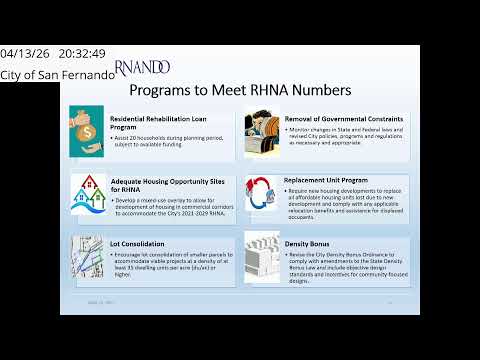
Consultant John Moreland (Rincon) told commissioners the updates reflect recently enacted state housing laws and a court decision requiring that sites in a housing element be zoned (not just overlaid). He said the changes do not increase base density or height limits and include: conversion of mixed‑use overlays to formal mixed‑use zones, updated residential standards to reflect state law (including ADU/lot‑split and child‑care provisions), objective design standards for site and building design, and revised parking and EV‑charging standards consistent with state law. Moreland emphasized the risk of not adopting the package: the city could be required to repay the grant, face decertification of its housing element, and be exposed to builders'‑remedy projects.
Commissioners asked whether components could be removed without jeopardy to grant requirements or HCD certification; consultants said some commercial/parking items could be pared back but cautioned that recent state bills (including AB‑2097 and updates tied to high‑quality transit definitions) and CalGreen requirements limit local discretion on parking and other standards.
A major theme was municipal parking. Commissioners pressed staff and counsel on whether city‑owned parking lots identified in the housing element could be protected from future development. City Attorney Richard Padilla told the commission that the city owns those lots and can choose not to dispose of them, but that the housing element process requires including sites available for housing and any change to the housing element to preserve a site would require an amendment and likely an offset under the state's no‑net‑loss rules.
Public commenters raised concerns about infrastructure, drainage, parking and the loss of local control. Staff recommended the planning commission's approval to the council and proposed including a recommendation that the council consider protections for city‑owned parking lots. Commissioners agreed to that recommendation and voted to forward the package to council; the motion passed 5–2–0.
Staff noted the grant deadline (June 30) and limited scope to request an extension; staff said SCAG had declined an extension request. The commission and staff discussed preparatory steps for the next housing element cycle (2029), including early budgeting for studies and potential advocacy at the state level.
The commission's recommendation will be transmitted to the City Council for final action; staff will include the commission's suggested language concerning parking‑lot protections in the transmittal to council.