Get Full Government Meeting Transcripts, Videos, & Alerts Forever!
Get email alerts on the Urine Recycling And Contaminants topic
No spam. Unsubscribe anytime.
Julia Cavicchi: urine recycling poses low human-health risk from pharmaceuticals and contributes negligible PFAS compared with background soil levels
Summary
At a Wareham community program co-hosted by the Wareham Land Trust and Nutrients Out of Wareham, Rich Earth Institute educator Julia Cavicchi summarized research showing trace pharmaceuticals from urine appear in crops and groundwater at extremely low levels and reported source-separated urine adds under 0.1% of background PFAS to soil in their tests; organizers urged sanitization and continued study.
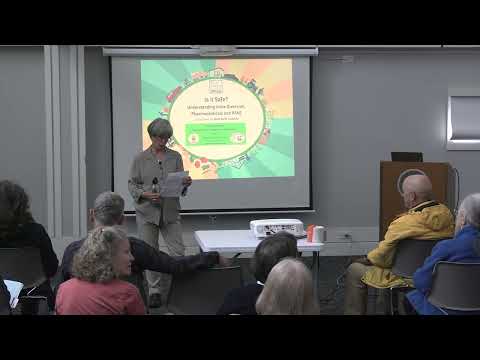
Julia Cavicchi, education director at the Rich Earth Institute, told about 60 attendees at a Wareham community meeting that recycling human urine as a fertilizer can play a role in easing nutrient pollution and local fertilizer costs while posing a minimal direct human-health risk from pharmaceuticals.
Cavicchi said conventional wastewater systems release most of the nitrogen and phosphorus that end up fueling harmful algal blooms and that source-separating urine — a small share of wastewater volume that contains a large share of nutrients — can conserve water and recover fertilizer for nearby farms. "There's no such place as away," she told the audience, drawing a through-line between household habits and watershed health.
Why it matters: the presenter framed urine diversion as a way to reduce nitrogen loading to coastal embayments and to provide a locally produced fertilizer as global fertilizer prices rise. She noted urine contains largely nitrogen and smaller amounts of phosphorus and potassium, and that reusing those nutrients may help farmers facing price and supply volatility.
Evidence summarized: Cavicchi described a six-year study conducted with the University of Michigan, the University at Buffalo and the Hampton Roads Sanitation District that tested community-collected urine applied to lysimeter plots growing carrots and lettuce. The research found pharmaceutical compounds present at very low concentrations — in the nanogram-per-gram (parts-per-billion) range in crop tissue and parts-per-trillion in groundwater — and characterized human exposure from eating such crops as extremely small. "You would have to eat a pound of urine-fertilized lettuce every day for a thousand years to get back a whole cup of coffee," she said to illustrate scale.
On antibiotics and resistance, Cavicchi summarized partner research showing sanitization (storage or pasteurization) kills resistant bacteria and that released DNA from those killed cells did not transfer resistance genes to soil microbes in the study plots.
Sanitization and treatment: the Rich Earth program pasteurizes community-collected urine (about 1.5 minutes at roughly 80°C in the device described) or relies on storage methods recommended by the World Health Organization for home use (one month to greatly reduce pathogens; six months to further reduce risk). Cavicchi also described granulated activated carbon filters as an optional additional step to remove pharmaceuticals.
PFAS and biosolids: turning to PFAS, Cavicchi cautioned that biosolids (the solids from wastewater treatment plants) commonly contain PFAS at widely varying levels because wastewater aggregates many household and industrial sources. She reported that, in their comparative testing, applying source-separated urine added less than 0.1% of the PFAS already present in typical background soil and rain inputs to a square meter of cropland. By contrast, biosolids can contribute substantially higher PFAS loads; she cited Maine's experience banning land application of biosolids after PFAS contamination and described the consequential logistics challenges for that state.
Research into mitigation: the Rich Earth team is investigating biochar made from biosolids and other feedstocks; literature shows pyrolysis can reduce PFAS by a reported 74%–99.9% in some studies, but Cavicchi stressed uncertainties remain (possible formation of other PFAS fragments, air/byproduct handling), and community concerns have arisen about siting pyrolysis plants.
Local and policy context: Cavicchi noted regional piloting — including a funded 25-household urine-diversion project in Falmouth with additional MassDEP support — and referenced two Massachusetts bills mentioned during the talk: S1504 (to regulate PFAS as a class and restrict PFAS in some products with a 2030 phaseout target) and S2802 (to protect farmland by banning land application of PFAS-containing biosolids and fertilizers).
Audience questions: residents pressed on definitions of "healthy" for home-use urine (urinary tract infections and people undergoing chemotherapy were cited as exceptions to home-use recommendations), EPA monitoring and regulation timelines (the presenter said federal listing or monitoring could take years), container sizes and storage logistics (an approximate figure of 150 gallons of urine per person per year was discussed), and the degree to which urine must be source-separated to avoid contamination from other wastewater flows.
What’s next: organizers invited attendees to a June 9 session focused on home gardening with urine-derived fertilizer and offered tours of a Falmouth demonstration site and the Rich Earth facility. Attendees were given handouts, business cards and sign-up opportunities to join local pilots.