Get Full Government Meeting Transcripts, Videos, & Alerts Forever!
Get email alerts on the District Strategy topic
No spam. Unsubscribe anytime.
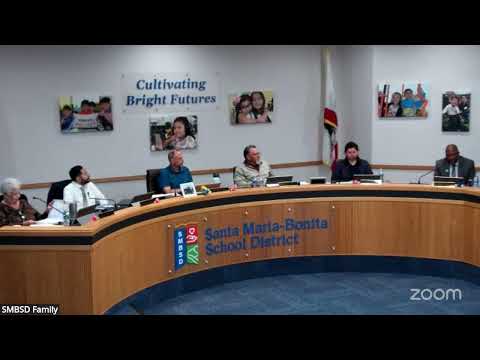
District presents Bright Futures end-of-year update, outlines curriculum alignment and community schools expansion
Summary
Santa Maria-Bonita leaders presented year-one outcomes for the Bright Futures Project: TK–8 ELA learning-cycle matrices and common assessments, UDL rollout, restorative practices, counselor baseline work, and awards of 21 community-schools grants with eight specialists hired.
District leaders presented a comprehensive end-of-year report on the Bright Futures Project, the multi-year initiative to redesign instruction and student supports across Santa Maria Bonita schools.
Project leads said year one focused on building a common instructional "floor" across sites. Curriculum teams completed year-long matrices for learning cycles (TK–8 ELA and 7–8 math) and developed teacher-created common assessments to be implemented next year to measure alignment with state grade-level expectations. "Our goal in this work is to raise that floor to meet the state grade-level expectations," a curriculum lead said.
The district also rolled out Universal Design for Learning (UDL) training and embedded restorative practices to reduce barriers to learning and build classroom belonging. An implementation lead explained that UDL is being positioned as a tier-one best practice — not a special-education add-on — and restorative approaches will be used both in classrooms and in tiered discipline/truancy supports.
Counseling services received a baseline study; leaders reported progress toward having counselors at every elementary site and increased junior-high counselor staffing, but also noted remaining gaps in counselor-to-student ratios and the need for a multi-year plan to protect counselor time and coherence across 21 sites.
Community schools work was highlighted as a core element: the district received 21 community‑schools grants (the second-largest grantee in the state), hired eight community‑school specialists at early-adopter sites, created an LEA steering committee, and began needs-and-assets assessments tying community partnerships to site supports.
Board members and staff discussed fidelity, staffing needs for sustainable implementation, and plans for next year’s "activation" phase emphasizing common assessments, PLC-driven lesson tuning, and targeted EL/UDL supports.
What's next: Begin district-wide implementation of learning cycles and common assessments, continue UDL lesson-tuning in PLCs, finalize multi-year counselor and staffing plans, and expand community-schools specialists in cohort-two sites.