Get Full Government Meeting Transcripts, Videos, & Alerts Forever!
Get email alerts on the Public Health Policy topic
No spam. Unsubscribe anytime.
Board debates 1,000-foot ‘safe school zones’ for mobile syringe distribution; health, legal and provider concerns aired
Summary
At a May 28 work session commissioners reviewed a proposed ordinance to prohibit mobile syringe distribution within 1,000 feet of schools. Public health offered updated implementation costs, the district attorney’s office voiced support, and harm-reduction providers and neighborhood groups clashed over evidence and operational impacts.
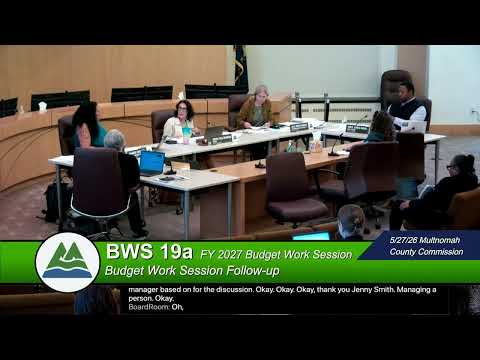
The Multnomah County Board opened a work session on May 28 to consider an ordinance that would bar mobile syringe distribution within 1,000 feet of schools. The proposal prompted extended public testimony, technical briefings from county public-health staff, and legal commentary from the district attorney’s office.
Public-health director Kirsten Erd (recorded on the public record) provided a revised implementation cost range and staffing estimate after earlier briefings: earlier estimates had been in the $131,000–$144,000 range for initial costs (with six-month ramp-up), but an updated accounting increased that estimate by roughly $27,000–$30,000 because county staff concluded that certain enforcement and education activities would need to begin immediately rather than being phased in. ‘‘The range right now is... about $27 to $30,000 more,’’ Erd told the board, explaining changes tied to immediate enforcement and outreach assumptions.
Neighborhood groups and parents told the board they had documented repeated public injections, discarded syringes in storm drains and children exposed to drug activity along school routes. Michelle Miller of the Stadium Neighborhood described a packet documenting ‘‘children in proximity to active drug use inside a posted school zone, repeated public injections, syringe disposal into storm drains, recurring biohazardous debris, and the absence of any cleanup, reporting, registration, or operational accountability mechanisms.’’ Several neighborhood witnesses urged stronger accountability and enforcement language.
Harm-reduction providers and outreach operators disputed the causal link between mobile syringe programs and public drug litter. Provider Michael Gilbert said outreach teams operate where unmet need exists and that his organization leaves an area when it is not an appropriate location; he added that proximity-based restrictions were not an evidence-based solution to public drug litter. ‘‘Proximity based restrictions on public health outreach programs are not among [evidence-based] solutions,’’ Gilbert said, adding that providers bring sharps containers and do cleanup work.
Legal counsel and the Multnomah County District Attorney’s Office framed the proposed buffer as aligned with state law concerns. Mariel Mod, chief deputy in the district attorney’s office, said DA Mike Vasquez ‘‘supports this amendment without reservation’’ and explained how Oregon statutes that penalize delivery within 1,000 feet of a school could intersect with public distribution activities. The office also referenced long-standing neighborhood complaints about open-air drug use and litter in affected areas.
Commissioners debated operational details including whether to include preschools, how to treat facility-based providers who temporarily operate from a mobile van during a building outage, and whether to set an explicit effective date or ramp-up period. Commissioners asked county staff to draft narrowly tailored waiver language to allow rare, facility-driven temporary mobile operations (for example, when plumbing problems force temporary outdoor van-based service), while avoiding broad waivers that would dilute the buffer.
The chair scheduled a second reading and potential vote for June 11. Public-health staff said they would refine cost estimates and implementation plans and the board directed staff to circulate potential waiver and effective-date language for the June 11 meeting.
The work session recorded areas of agreement (neighborhood concern about drug litter near schools) and points of dispute (the ordinance’s efficacy in reducing litter, operational impacts on providers and exact enforcement mechanisms). The board did not take a final vote on the ordinance during the May 28 meeting.