Get Full Government Meeting Transcripts, Videos, & Alerts Forever!
Get email alerts on the Insurance Vendor Selection topic
No spam. Unsubscribe anytime.
Committee votes to pursue League insurance program after presentation citing roughly $39,000 in savings
Summary
The Viroqua Finance and Personnel Committee voted to pursue the League of Wisconsin Municipalities’ insurance program for 2026 after a detailed presentation that highlighted broader per-occurrence liability limits, replacement-cost property coverage and member services; staff said the League proposal was about $39,000 less than the current broker’s apples‑to‑apples estimate.
The Viroqua Finance and Personnel Committee voted to pursue membership in the League of Wisconsin Municipalities’ municipal insurance program for 2026, citing a staff comparison that showed roughly $39,000 in net savings compared with the current broker’s quote.
The motion, made by John and approved on roll call, follows a 50‑minute presentation by Ryan, identified in the transcript as the League representative. Ryan told the committee the League program is municipal‑only, has about 550 participating public entities and offers a range of coverages and mitigation services. “This program’s been in place since 1984,” he said, and described it as a captive‑style municipal pool focused on city and village risk needs.
Ryan walked members through limits and coverage differences. He said the village currently carries a $1 million underlying limit with a $2 million umbrella (three million per occurrence) and that the League’s structure would extend per‑occurrence limits without an aggregate cap. He pointed to large land‑use settlements in the program—examples he cited at about $4.7 million and $4.5 million—to explain why higher per‑occurrence limits can matter. He also noted that Wisconsin statutory caps for most municipal liability claims are much lower (as discussed in the presentation, $50,000 for property damage and bodily injury and $250,000 for public‑entity auto liability as stated in the meeting), but warned statutory protections may not apply to federal civil‑rights litigation, which can lead to larger exposures.
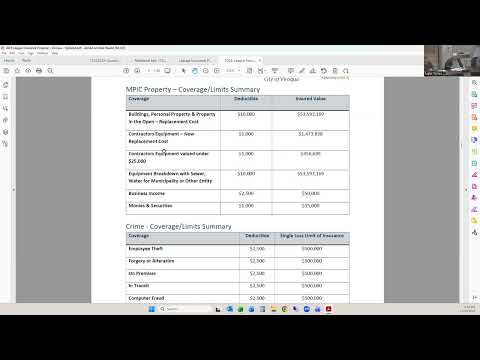
On property and equipment, Ryan said the League quotes buildings on a guaranteed replacement‑cost basis and proposed replacement‑cost coverage for contractor equipment (the committee’s current program used actual‑cash‑value methods for some equipment). He described additional coverages the League places through Municipal Property Insurance Company and estimated a municipal property rate of about $0.06 per $100 of value in the League program compared with higher private‑sector rates.
Ryan and staff also reviewed workers’ compensation and loss‑control features. Ryan cited the village’s experience modification factor (1.43 as discussed) and said recent losses tied to that factor produced about $20,000 in additional premium. He emphasized the League’s nurse case hotline, training, crime‑coverage options and an employee assistance/ready‑rebound program intended to reduce indemnity and lost time that drive experience‑mod increases.
Staff presented a side‑by‑side cost comparison and recommended pursuing the League program. Lori summarized bill and coverage comparisons and said the League estimate was “39 to the positive” compared with EMC on an apples‑to‑apples basis. Committee members pointed to that dollar figure and the additional member services—training, legal resources tied to employment‑law specialists and safety grants—as reasons to change providers. Several members noted the League offers a flat 20 percent dividend (estimated in discussion at roughly $11,000–$12,000 back as a sample figure) for the first years and a 4 percent safety grant to reimburse safety material purchases.
John moved to pursue the League program; the motion was seconded and passed unanimously on roll call by members present.
What happens next: staff will pursue formal quotes and plan implementation details for the League program ahead of renewal and bring any required contract or ordinance language back to the committee and council for final action.