Get Full Government Meeting Transcripts, Videos, & Alerts Forever!
Get email alerts on the Sidewalks topic
No spam. Unsubscribe anytime.
Rocky Hill committee prioritizes sidewalk fund and advances 'complete streets' checklist
Summary
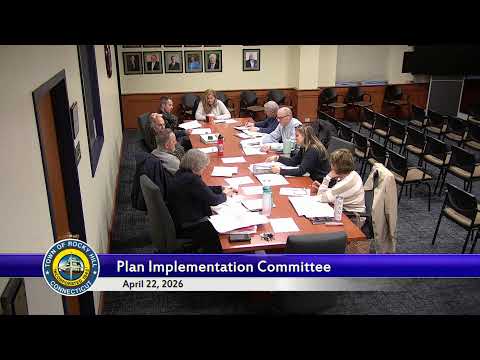
At its April 22 meeting the Plan Implementation Committee prioritized revisions to the town’s sidewalk ordinance and the creation of a dedicated sidewalk fund, reviewed a draft complete-streets assessment checklist, and adopted an every-other-month meeting schedule to keep momentum on POCD implementation.
The Plan Implementation Committee of Rocky Hill spent most of its April 22 meeting moving the town closer to a retooled sidewalk ordinance and a formal mechanism to collect and use sidewalk waiver fees.
Committee members said they want the ordinance to apply beyond subdivisions so commercial and site-work applicants who seek a sidewalk waiver would pay into a single, dedicated sidewalk fund rather than having those waiver payments fall into general-purpose accounts. The discussion repeatedly returned to the same practical questions: how to define which projects pay the fee, how to account for the money so it is reserved for sidewalks, and how to present the ordinance language to the town council for public hearing.
The committee heard staff and planning officials outline options for implementation. Members described three funding paths that already are being used or pursued: (1) developer-sidewalk bonds tied to projects, (2) a local sidewalk-waiver fee deposited into a separate line item, and (3) outside grants and capital-improvement funds to supplement local resources. Committee members used an approximate planning figure of $100 per linear foot as a working estimate of sidewalk construction cost when discussing how waiver fees should be calculated and held.
Members also reviewed a draft "complete streets" assessment checklist intended to make evaluations of road segments consistent. The checklist groups items that engineering and planning staff plan to inventory — motor-vehicle operations and speeds, crash history, pedestrian facilities and ADA ramps, bike operations, transit stops, sight lines and emergency-vehicle access — so each corridor can be rated against a common standard. Engineering staff said the checklist is an assessment tool rather than an immediate construction plan; it will guide future grant applications and priority-setting for capital improvements.
Committee members agreed the engineering department is a natural owner for the checklist, and that additional data (police crash and speed reports, CT Transit routing, and ADA ramp inventories) will be needed to complete the assessment. Staff pointed to outside reviewers and ongoing DOT/CRCOG processes that sometimes provide the required data for towns.
The committee also reviewed economic-development updates (a business directory now on the town website, a planned restaurant week tied to the Italian festival, and a local manufacturer pursuing a $500,000 state grant) and several coordination items with parks, open-space and land-acquisition commissions about greenways and trail connectivity.
On process and next steps, members asked staff to draft inclusive ordinance language (modifying Section 212-9 as appropriate) and to add a sidewalk line item to the town budget — even with a zero balance initially — so the fund is visible during the budget process. The PIC did not set an exact fee formula at the meeting; staff and P&Z were asked to prepare language and accounting steps for a future meeting and for presentation to the council.
In a formal vote the committee adopted an every-other-month meeting schedule (option B) by voice vote; members indicated unanimous consent. The PIC set the sidewalk ordinance (Chapter 212 revisions) as a top priority for upcoming agendas and asked engineering and planning staff to return with a working checklist and draft ordinance language at the next meeting.