Get Full Government Meeting Transcripts, Videos, & Alerts Forever!
Get email alerts on the Zoning Formbased Code topic
No spam. Unsubscribe anytime.
Committee approves expansion of form‑based zoning for St. Clair Superior and Huff and bars data centers in rezoned area
Summary
The Development, Planning and Sustainability committee approved Ordinance 626‑2026 to extend form‑based zoning south of St. Clair Avenue between East 55th Street and Anzel Road, and voted to add a provision prohibiting data centers and similar principal uses within the rezoned parcels. Supporters said the change will make repairs and modest infill easier for longtime residents; some public commenters warned it could spur displacement.
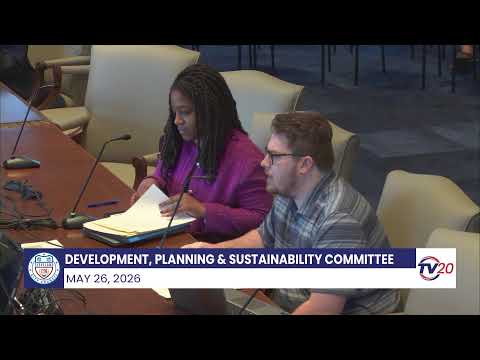
The Development, Planning and Sustainability committee on May 26 approved a zoning map change, Ordinance 626‑2026, to expand form‑based code zoning in parts of St. Clair Superior and the Huff neighborhood and added an amendment barring data centers from the rezoned properties.
Adam Davenport, manager of neighborhood planning, told the committee the shift from a use‑based code to a form‑based approach prioritizes building form and neighborhood scale over narrow use classifications. “If 80, 90% of the structures burned down today, they would be out of compliance with our own zoning code,” Davenport said, arguing the change will let homeowners repair and, when appropriate, add small accessory units without facing rebuilding barriers.
Shannon Leonard, chief zoning administrator, walked members through the new district types — including House 4 (allowing two‑family and up to four units), Neighborhood 2.5 (up to 2.5 stories and up to eight units), Community and Urban Flex districts for corridor sites, and Civic and Park designations to protect institutions and small open spaces. Leonard said the ordinance aligns with the city’s comprehensive plan and the St. Clair Superior community-building work.
Speakers from the public urged caution. Michael Armstrong, a resident of an existing form‑based pilot area, asked that the pilot be evaluated before an expansion and flagged a discrepancy between the planning commission map and the draft ordinance. Miss Greer, a longtime resident, told the committee she feared the rezoning would lead to residents being displaced: “If you’re coming in and take our lots… and put us out of our neighborhood, that is not what we want,” she said.
Administration staff repeatedly told the committee the city does not intend to take private property. “This rezoning is not about taking anyone’s property,” the city’s chief said, adding the intent is to align zoning with the existing built form so homeowners can make modest investments more easily.
During the meeting a council member moved to insert a new Section 10 prohibiting “data centers and substantially similar principal uses” within the properties rezoned by this ordinance. Staff and public commenters had repeatedly raised concerns about how the city’s form‑based code had categorized data centers as an office use when some contemporary hyperscale data centers are large, industrial proposals. The committee approved the amendment by voice vote and then voted to approve Ordinance 626‑2026 as amended; no roll‑call tally was read into the record.
Next steps: the ordinance will be forwarded per council process for final passage and formal codification. Planning staff said they will return to the planning commission and work with the law department to refine implementing language for the new Section 10 and for any needed clarifications between the ordinance and the planning commission maps.