Get Full Government Meeting Transcripts, Videos, & Alerts Forever!
Get email alerts on the Data Centers topic
No spam. Unsubscribe anytime.
Santa Fe County authorizes publication of 12-month moratorium on large data centers as officials weigh energy, water and climate impacts
Summary
The county voted to publish notice of a proposed 12-month moratorium on approvals for large-scale data center facilities to allow time for county staff, residents and experts to develop local guardrails on energy, water use, community impacts and economic terms.
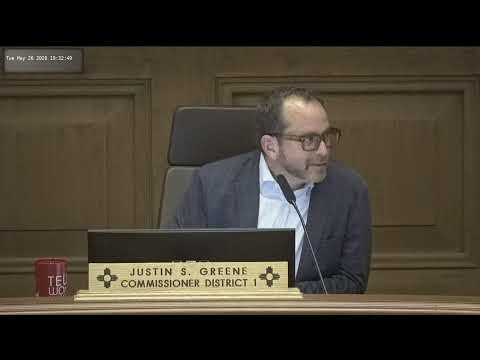
The Santa Fe County Board of Commissioners voted May 26 to publish the title and general summary of an ordinance proposing a 12‑month moratorium on development approvals and permits for large-scale data centers.
Supporters said the pause will give the county time to write rules addressing the rapid growth of hyperscale facilities and their local consequences. Commissioner Lisa Kakari Stone and Commissioner Hank Hughes framed the moratorium as a temporary measure to let the county craft “guardrails” on energy sourcing, on-site and off-site water use for cooling, traffic and neighborhood impacts, and potential county incentives.
Presentations from Western Resource Advocates and the National Association of Counties underscored the scale of the issue. Western Resource Advocates described how data centers’ cooling systems — and the power plants that feed them — can consume large volumes of water depending on cooling technology, and showed that on-site usage and the additional water tied to electricity generation can both be material. The group emphasized that dry-air cooling and advanced liquid-cooling systems consume far less water than conventional evaporative systems.
Speakers also briefed the board on New Mexico’s recent law changes (House Bill 93) that allow self‑powered data centers to sell excess electricity back to utilities under certain conditions — a change that can influence how developers plan microgrids and on‑site generation. The presenters warned that self‑sourced gas generation tied to some proposed facilities can produce very large greenhouse‑gas emissions if not constrained.
Commissioners said they were not seeking to ban facilities but to ensure any large projects that seek county approval meet local priorities: clear limits on water use, credible commitments to low‑carbon electricity, protections for agriculture and open space, construction mitigation, and community benefits such as workforce training and local hiring.
The board authorized publishing the moratorium’s title and summary — the first step in formally adopting an ordinance — and directed staff to return for the required public hearing (statutorily timed after publication). The hearing is scheduled under the county’s publishing timeline at the end of June.
What happens next: staff will collect public input and expert advice during the pause and propose a set of regulatory options and model conditions for commissioners to consider. The moratorium is intended to preserve county discretion while those rules are drafted and vetted with residents and utilities.
Speakers: Commissioner Lisa Kakari Stone; Commissioner Hank Hughes; Anna Lindon Weller (Western Resource Advocates); Deborah Kapalof (Western Resource Advocates); Dr. Shelby Buds (National Association of Counties); Attorney Boyd.
The board will consider final action after the public hearing required by state law and after staff completes recommended guardrails and impact analyses.