Get Full Government Meeting Transcripts, Videos, & Alerts Forever!
Get email alerts on the Municipal Budget topic
No spam. Unsubscribe anytime.
Smithville council workshop weighs 5% budget cuts, tax options and a possible tax note to fund wastewater, radios and capital needs
Summary
At a lengthy FY2526 workshop the city manager outlined a $16.7M budget, a council-assigned 5% ($836,000) reduction exercise, newly identified revenue, and staff proposals to prioritize employee pay, wastewater capacity and capital equipment; council directed staff to research a tax note and other options.
Smithville’s City Council spent the July 23 meeting hour reviewing the FY2526 preliminary budget, debating proposed service cuts, and giving staff direction to pursue financing options for infrastructure.
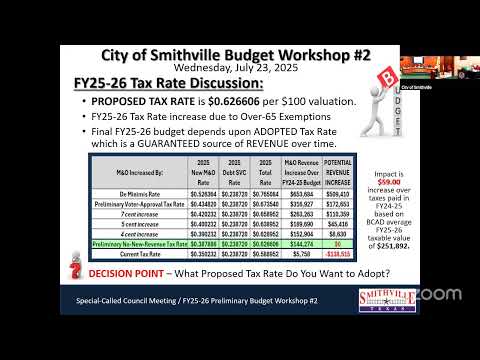
City Manager Robert said the city faces a $16.7 million baseline budget and that the council had instructed staff earlier to produce a plan showing a 5% reduction (about $836,000). Staff presented a hybrid zero-based line-item review. Robert told the council staff had identified about $233,000 in additional FY26 revenue since the last revision and emphasized the combined effect of falling appraisal values and increasing over-65 exemptions on the city’s no-new-revenue tax rate. He warned that some cuts would affect citizen services and employee morale.
Staff proposals and impacts: the budget book and staff presentation proposed a range of revenue measures (on-demand leaf-and-limb pickup, fee increases for golf-cart permits and roll-off containers, a possible animal-pickup fee) and identified discretionary cuts: program funding for community organizations, selected facility maintenance, training reductions, and temporary elimination of janitorial services at the rec center. The manager also showed that rising costs — vehicles, protective equipment, and insurance — have driven baseline expenditures higher.
Council priorities and direction: council members repeatedly said their top infrastructure priorities are wastewater/water capacity and capital needs (including police vehicles and radios). The mayor and several members urged pay increases and retention steps for city employees, saying staffing shortages are already affecting operations. Council and staff discussed tax-rate scenarios (the ‘‘no-new-revenue’’ and the voter-approval ceiling), and asked the city manager to pursue a debt financing option (a tax note) to fund high-priority capital projects and grant matches. Staff estimated an initial tax-note planning target and said the finance adviser (Samco/Equivalent) could present options at the next regular meeting.
Nonprofit and community concerns: public commenters, including nonprofit leaders, urged the council not to impose rent and utilities on long-standing nonprofit tenants of city buildings, warning that such a change could jeopardize grants and programs for children and seniors. The council asked the city attorney and staff to research legal constraints and contract options.
Why this matters: the workshop shows council and staff balancing short-term service choices and long-term infrastructure needs. A tax note or bond — if adopted — would fund wastewater expansion and other capital priorities but would require public discussion and a financing plan. Employee pay, municipal services and the treatment plant were consistently flagged as urgent.
What’s next: staff will return to the council with a refined, balanced yellow-sheet budget after updated certified property values are published, with follow-up work to (1) model tax-note scenarios and debt-service impacts, (2) research legal options for nonprofit facility use and rent, and (3) propose a prioritized list of capital items that could be financed.