Get Full Government Meeting Transcripts, Videos, & Alerts Forever!
Get email alerts on the Public Safety Apparatus topic
No spam. Unsubscribe anytime.
Hainesport officials hear urgent case for ladder truck as township grows
Summary
At a July 29 work session, the Hainesport Township Committee and the volunteer fire company discussed buying a combined ladder/rescue 'quint' versus a conventional rescue pumper, current mutual‑aid limits, multi‑year delivery delays and possible funding options including capital reserves, grants and a proposed developer contribution.
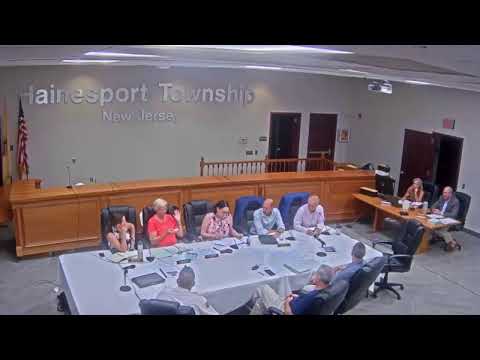
Hainesport Township officials and volunteers on July 29 laid out competing options for updating the volunteer fire company’s fleet as the township adds warehouses and multi‑story housing.
"We need to get an aerial device in place because of the growth in this township," Hainesport Volunteer Fire Company Chief Sean Bozart said, describing warehouses and three‑story apartments that current engine‑only equipment cannot fully serve. Bozart said the department regularly relies on mutual aid, but neighboring companies increasingly run 4,000+ calls annually and may be unavailable when Hainesport needs assistance.
Town staff and the fire company weighed buying a rescue pumper or a quint — a combined ladder and pump vehicle that provides elevated streams and rescue tools. Speakers said a new engine or rescue pumper is currently quoted at roughly $1.2 million and a demo quint at about $1.3 million, with manufacturers reporting 3–4 year build queues and repeated price increases. "If we wait a year, two years, you're going to be looking like one to three millions [for an engine]," one committee member said as department leaders cautioned that inflation and shifting emissions standards are adding to cost pressure.
Why the quint: Bozart argued a quint would improve reach and rescue capability, reduce the need to split limited crews, and supply onboard rescue tools and an elevated master stream that can be effective with smaller crews. He said the quint balances maneuverability (a 75‑foot model favored for tighter suburban streets) and capability in most three‑story situations, while 100‑foot ladders are typically reserved for larger high‑rises.
Town finance and capital posture: Town staff presented historical municipal support and recent capital allocations for the department, noting capital reserves and prior allocations that have totaled hundreds of thousands of dollars across recent years. Officials said the township currently has several hundred thousand dollars in capital savings and has budgeted additional amounts, and they described in‑kind support such as insurance and fuel. Staff also reported grant activity, including a pending SAFER recruitment/retention application and earlier ARPA funds used for PPE.
Public input and outside offers: During public comment, multiple residents and a regional fire director urged immediate purchase. The director of the neighboring Mount Holly Fire District publicly urged the township to "buy the damn truck," and several residents described incidents that, they said, demonstrated response risk. One member of the public said a proposed self‑storage redevelopment could bring a $25 million ratable and that the developer was prepared to offer roughly $400,000 toward a truck as part of redevelopment negotiations.
Next steps: Committee members and staff said no formal vote was taken at the session. Administrative steps described at the meeting included finalizing a draft ordinance to clarify municipal provision of fire services, completing an ISO (Insurance Services Office) assessment (data collection is complete) and drafting a fire‑services agreement and a job description for a part‑time fire coordinator. Officials said procurement timing, grant outcomes and available capital will shape whether the township orders an apparatus now or continues to save.
What remains unresolved: the committee has not decided whether to buy a quint, a rescue pumper or delay purchase; the SAFER grant outcome and any developer contribution are not settled. Committee members said they will continue evaluating the tradeoffs between immediate capability and budget impact before a formal appropriation or purchase decision is scheduled.