Get Full Government Meeting Transcripts, Videos, & Alerts Forever!
Get email alerts on the Municipal Budget topic
No spam. Unsubscribe anytime.
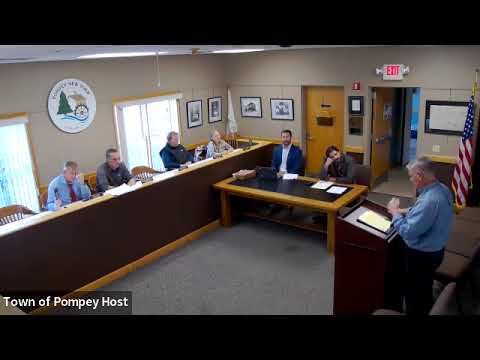
Residents press Pompey Town Board over salary increases and cuts during preliminary budget hearing
Summary
At a June 1 public hearing on Pompey's preliminary budget, residents questioned a proposed pay increase for the code enforcement officer, the corrected town clerk salary and a reduced line for extra police patrols; the board opened the hearing by motion and plans to finalize the budget at a later meeting.
Pompey — Residents raised questions about proposed pay increases and service changes at a public hearing on the town’s preliminary budget, focusing on a raise for the code enforcement officer, a corrected town clerk salary and reduced funding for extra police patrols.
At the opening of the hearing, the presiding official moved to lay the notice and open the public hearing, a motion that was seconded and approved by voice vote. Three residents signed up to speak and took turns questioning line items and staffing commitments.
“I’m kind of wondering about the bump in the code enforcement officer salary — does that mean that we’re going to get Tim Barrett more hours in our town and if so will those hours be posted somewhere?” resident Lisa Miles asked, pressing the board to explain how a higher salary would translate into in-person availability for permit applicants.
Staff said Barrett will devote more hours to the town in the coming year but that his schedule is not fixed to a set minimum or maximum weekly hour total. Residents said the town attorney, Dave Capriotti, had been cited in earlier discussions as advising staff about interactions; attendees disputed whether the attorney had told the officer not to meet with residents, and staff and residents offered different recollections during the hearing.
Linda Hurley flagged an error in the public notice for the town clerk’s salary and asked whether it had been corrected. “The town clerk’s salary that I’m looking at is 20 — we made a mistake; we corrected that,” the clerk replied, confirming that the correct annual salary is $41,000 and that the revised figure will appear in the final budget.
Resident Jim Goer questioned several finance lines. He asked why projected interest revenue stands at $7,500 for the general fund but $20,000 for the highway fund; staff explained the difference reflects larger balances in the highway fund and that the town’s funds are pooled through New York CLASS, a municipal investment vehicle. Goer also raised the decision to reduce the police contractual line from $23,500 to $13,000, asking what services would be cut. Staff said the town lowered the projection because it can no longer reliably obtain extra patrols from the county sheriff’s office and therefore reduced the budgeted amount to reflect likely spending.
Goer and other speakers pressed the board on expectations tied to higher pay for code enforcement: residents argued that higher salaries should include posted minimum hours (one resident cited 30 hours/week as an example) so that permit applicants can rely on in-person access. Staff repeated that the position is budgeted as less than full time and that specific hourly commitments are not currently set.
The hearing also included questions about small contractual and equipment lines: staff said the eCode update is budgeted at $1,350, a computer and printer at $2,000, and other contractual expenses at about $600, explaining department accounts are divided into personnel, equipment and contractual categories.
After the public comments, the board discussed procedural timing and voted to close the public hearing so it could finalize the budget before the next scheduled meeting. The clerk said final adjustments — including updated employee retirement invoices and corrected salary figures — will be circulated ahead of the board’s vote on the adopted budget, anticipated at a future meeting (referenced by participants as 'Tuesday').
No formal budget adoption occurred at the hearing; the board left the public record open long enough to collect corrections and will return with a final proposed budget for formal adoption.