Get Full Government Meeting Transcripts, Videos, & Alerts Forever!
Get email alerts on the Solid Waste Recycling topic
No spam. Unsubscribe anytime.
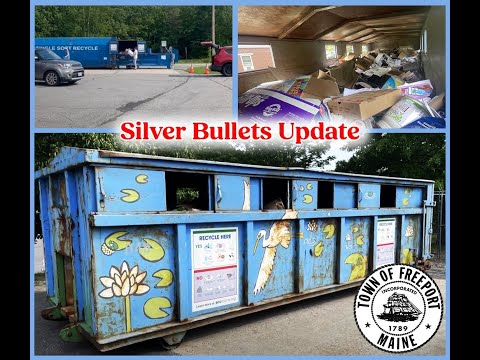
Freeport council keeps West Street recycling bin, votes to remove one silver —bullet and fund a yearlong education trial
Summary
After hearing a report from the Freeport Sustainability Advisory Board and presentations on hauling and tipping costs, the town council voted to remove one of the town's silver-bullet recycling containers, retain the West Street site for one year, and direct FSAB and staff to run an education campaign and return with metrics by January.
The Freeport Town Council voted to remove one of the town's unattended silver-bullet recycling containers and keep the West Street site for a one-year pilot while the Freeport Sustainability Advisory Board (FSAB) and town staff run an education and outreach campaign and report back with metrics by January.
FSAB co-chair Mandy McFersonen presented the advisory board's report and recommended updating the town's Solid Waste ordinance (it still lists four silver bullets) and retaining one centrally located container for a year to allow behavior-change work to proceed. "We were just going to give a short synopsis so we could have more time if you have any questions," McFersonen said, noting FSAB's emphasis on reduce, reuse, recycle and compost strategies drawn from Maine's solid waste hierarchy.
Resident and former FSAB member Rod Brigger opened the budget argument, detailing hauling inefficiencies for uncompacted silver-bullet loads. He said uncompacted loads from the two off-site silver bullets generated many more trips than compacted loads at the transfer station and estimated the town paid roughly $70,000 last year for transport of the two silver bullets versus under $20,000 for compacted transfers. "We're spending a lot of money hauling air," Brigger said, urging the council to consider potential transport savings if fewer unattended bins are collected.
Councilors and staff clarified that Brigger's hauling figures excluded tipping fees. A town representative who said they sit on the EcoMain board reported the current fiscal-year tipping fee has been set at $110.75 per ton for both recycling and solid waste and that recycling fees could rise toward about $135 per ton over the next two to three years.
FSAB members emphasized education, on-site staffing and better signage as ways to reduce contamination and preserve recycling habits. McFersonen and other FSAB speakers noted a 2019 summer intern who staffed silver-bullet sites produced measurable improvement while present and urged a sustained outreach effort rather than a single mailing. "If people lose the habit they're not coming back to it," McFersonen said, arguing that keeping one centrally located bin would preserve convenience while the town tests alternatives.
Councilors debated the trade-offs. Some said convenience matters to busy households and multi-family dwellings that lack curbside recycling, while others focused on operational efficiency and rising processing fees. One councilor moved to remove both silver bullets, but that motion failed after a voice vote.
Later the council approved a motion to remove one silver bullet, retain the West Street container for a year, and charge FSAB and staff with designing an education and outreach plan and a set of metrics. The council asked FSAB and the assigned staff person to return with a plan and performance measures by January. Caroline (staff person on FSAB) agreed FSAB would begin the education discussion at its next meeting and report back.
The council left the decision framed as a transition: remove one unattended bin now, run an education trial and use the resulting data to decide whether to remove the remaining bin later. The town will also consider ordinance updates to reflect current container locations.
What's next: FSAB and town staff will develop a formal education and metrics plan, report back to the council by January, and the council can reverse course if the pilot fails to meet the agreed metrics.