Get Full Government Meeting Transcripts, Videos, & Alerts Forever!
Get email alerts on the Energy Efficiency topic
No spam. Unsubscribe anytime.
REAP presenter outlines practical home energy-efficiency steps for Sitka residents and available federal incentives
Summary
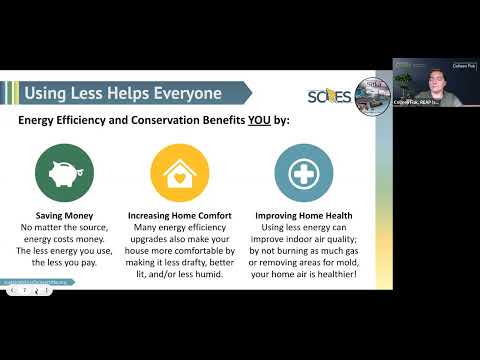
Colleen Fisk, education director at REAP, told a Sitka webinar that small conservation actions plus efficiency upgrades can lower costs, improve comfort and extend the town’s renewable electricity for future electrification; she highlighted heat-pump resources and federal tax credits.
Colleen Fisk, education director at Renewable Energy Alaska Project (REAP), urged Sitka residents to combine simple conservation habits with efficiency upgrades to reduce household energy costs and preserve local renewable electricity during a lunchtime webinar hosted with the City of Sitka. "We just want to maximize our energy savings," Fisk said, emphasizing practical steps homeowners can take this fall.
Fisk framed the talk around four objectives set by the Sitka Sustainability Commission: everyday energy choices that influence Sitka’s energy future, roles individuals and institutions play in efficiency and conservation, the role of policy, and the benefits to Sitka residents. She noted Sitka’s electricity is produced largely from local hydro (Blue Lake and Green Lake), adding that the supply is renewable "but it's not unlimited," so residential reductions have measurable effects.
The presentation distinguished conservation (behavioral changes, such as turning off lights) from efficiency (technology upgrades, such as LED bulbs or ENERGY STAR appliances). Fisk used common examples to quantify gains: older incandescent bulbs convert about 10% of electricity into light, compact fluorescents roughly 40%, and LEDs substantially more, making LED replacement a low-cost efficiency step. She also described the efficiency advantages of electric vehicles and regenerative braking over internal-combustion drivetrains.
For home heating, Fisk recommended programmable thermostats when compatible and cited a general winter setpoint range of 62–68°F, noting that "every degree that you turn the heat down you save 2% on your heating bill." She advised setting hot-water thermostats near 120°F for most systems (and not reducing boiler settings below manufacturer guidance for mineral-buildup and safety), and said correcting hot-water temperatures can yield "up to 10%" savings on energy bills.
Fisk explained heat pumps as efficient systems that move rather than generate heat and pointed listeners to Alaska Heat Smart, which provides residential evaluations and funding help for low-income households. She summarized federal tax incentives available under recent legislation, saying a 30% tax credit applies to qualifying heat pumps, efficient biomass stoves and boilers, and cited examples of caps (for certain measures her slides noted up to $2,000). Fisk also announced a same-day Alaska Housing Finance Corporation (AHFC) publication, "Heat Pumps in Alaska," as a localized resource.
On weatherization, Fisk recommended sealing air leaks (caulking for small gaps, spray foam for larger openings), upgrading exhaust fans to quieter, more efficient models, and using window-insulation kits for rentals. She described federal tax-credit rules that commonly cover material purchases (examples she cited included up to $1,200 per year for some weatherization purchases and up to $600 per year for window purchases) but typically exclude installation costs.
Practical tips included using plug-in electricity monitors to reveal high-use devices, consolidating multiple freezers when possible, turning off devices via power strips to stop 'vampire loads,' and using timers for vehicle block heaters so they run only about two hours before departure rather than all night. Fisk also encouraged residents to read kilowatt-hours (kWh) on the Sitka utility bill as the principal consumption metric; she cited an average Sitka retail rate of about 17 cents per kWh during the season described in the webinar.
Fisk closed by promoting additional resources — REAP and AHFC materials, an AK Energy Smart checklist and a self-paced online course on home energy efficiency — and reminded listeners of upcoming webinars, including an October 24 session on energy economics and a future panel on heat pumps and emergency preparedness. The hosts said the webinar recording would be posted on the City of Sitka website after editing.
This session focused on practical, resident-level measures and where to find further technical or financial help; it did not include policy votes or formal municipal actions.