Get Full Government Meeting Transcripts, Videos, & Alerts Forever!
Get email alerts on the School Finance topic
No spam. Unsubscribe anytime.
Othello board reviews tax scenarios as district weighs capital levy and future bond for school construction
Summary
Othello School District officials reviewed scenarios that pair a short-term capital levy with a future bond to address building needs, including sample tax impacts and a possible state match that could reduce local borrowing needs.
The Othello School District board on an announced meeting reviewed tax scenarios for financing possible school construction and capital repairs, discussing a capital levy as a short-term bridge and a larger bond for later construction.
Dr. Meek, presenting the Future Ready Schools update, said the district is examining both capital levies and bond measures because Washington law limits districts’ options for capital finance. "In our state there are basically two different ways that you can pay for capital work," he said, explaining that levies and bonds, rather than loans, are the typical mechanisms.
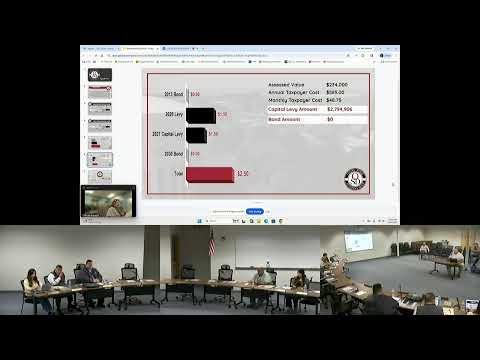
He laid out sample figures for 2027: a projected bond component of about $0.97 per $1,000 of assessed value plus a $1.50-per-$1,000 levy (presented in materials as $150), which together were shown in the presentation as roughly $2.47 per $1,000. Using the presentation's median property value of $341,000, the combined scenario was illustrated as about $842 per year (roughly $70 per month) for that median-valued property.
Dr. Meek also described the district's theoretical debt capacity under state rules (limited to 5% of assessed valuation) and said that capacity would allow up to about $151 million in bonds under the illustrative assumptions, which the presentation showed as a bond-rate scenario of about $2.44 per $1,000. He noted that many districts choose to phase projects to avoid stacking large levies and bonds at the same time and suggested phasing or smaller bond packages could be considered.
The presentation included potential revenue estimates for a capital levy: at $1.50 per $1,000 the district would generate a projected "just over $4 million a year" in capital-levy funds for short-term projects such as roofing, playground upgrades, gym repairs and a food service warehouse, Dr. Meek said.
Board members asked clarifying questions about state matching funds and SCAP eligibility. Dr. Meek said the district may qualify for about $50 million in state match for a large project, and clarified that SCAP funding ties to facility age and unhoused-student counts rather than the district's debt capacity.
Directors stressed transparency and public trust as priorities if the district moves toward a capital measure or bond. The board asked for a concrete list of candidate projects the capital levy would fund; Dr. Meek said staff will provide that project list and visuals at the next Future Ready Schools meeting.
Next steps: the board was told it will revisit these scenarios at a future board update on June 22 and that staff expect to return in the fall with a formal recommendation and the procedural steps necessary to place a capital levy before voters if the board decides to proceed.