Get Full Government Meeting Transcripts, Videos, & Alerts Forever!
Get email alerts on the Living Shorelines topic
No spam. Unsubscribe anytime.
City-supported living-shoreline designs to be offered to waterfront homeowners
Summary
Ecosphere Restoration Institute presented three template living-shoreline designs for three waterfront properties in the Donses neighborhood; the city supported the work with a $39,000 grant and will distribute engineering templates and a homeowner permitting guide to encourage cost-effective shoreline adaptation.
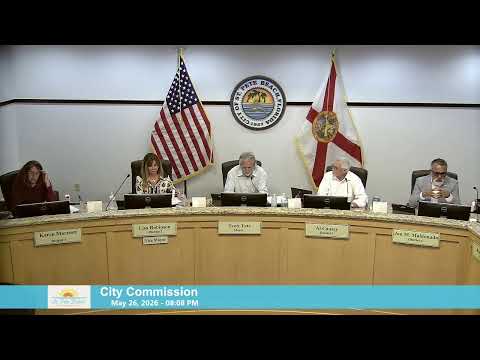
At the May 26 meeting the City Commission heard a presentation from the Ecosphere Restoration Institute on living-shoreline and "living seawall" designs created for three waterfront homes in the Donses neighborhood.
Camden Mills, public services director, introduced Tom Reese of Ecosphere Restoration Institute, who explained that living-shoreline approaches combine rock veneers, sediment tubes and plantings (including trimmed mangroves where appropriate) placed in front of an existing seawall to provide habitat and reduce wave energy.
Reese said the project received a roughly $39,000 grant and that the engineering designs were prepared so homeowners could use template drawings that reduce the time and cost of permitting. "We designed these specifically so you only need one permit instead of four," Reese said, explaining that streamlined permitting can shorten a typical six-month timeline.
Commissioners and residents asked about insects, viewshed impacts and applicability to neighboring properties. Reese said he did not expect the limited tidal plantings proposed for Gulf-facing properties to create large insect problems and noted that the designs can be adapted: in cases where mangroves already exist over older seawalls, a low "seat wall" about 16 inches above grade can be tied to adjacent seawalls to raise the effective elevation without removing the mangroves.
Reese said the design set targets an inner tidal elevation near 5 feet to reduce everyday king-tide flooding; he cautioned the approach will not protect against a major hurricane but can help with high tides and small storms. He also said a contractor list and homeowner permitting guide would be distributed to residents once final tweaks and permitting clarifications are complete.
Why it matters: living-shoreline approaches aim to retain or re-create nearshore habitat while providing wave energy attenuation; locally adapted, lower-cost template designs can lower barriers for individual homeowners who must pay for seawall work.
Provenance: Presentation introduced by Camden Mills SEG 068; full presentation and Q&A SEG 068–SEG 292.