Get Full Government Meeting Transcripts, Videos, & Alerts Forever!
Get email alerts on the Gulf Boulevard Undergrounding topic
No spam. Unsubscribe anytime.
St. Pete Beach pauses Gulf Boulevard undergrounding; staff to reallocate city funds and seek pedestal hardening options
Summary
After a lengthy review of costs, easement gaps and resiliency trade-offs, the St. Pete Beach commission directed staff to discontinue work on Phase 2A of the Gulf Boulevard undergrounding project, re-evaluate the city's $1.4 million budgeted contribution and pursue options to mitigate flood vulnerability at utility endpoints.
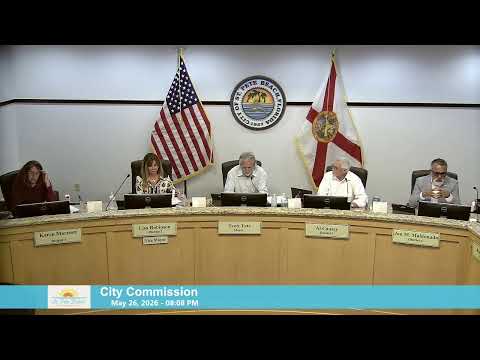
The St. Pete Beach City Commission on May 26 directed staff to discontinue work on Phase 2A of the Gulf Boulevard utility undergrounding project and to recommend a reallocation of the city's $1.4 million budgeted contribution during the FY2027 budget process.
Camden Mills, the city's public services director, told the commission the corridor project — which aims to place electrical, street lighting and communications facilities underground between 75th and 35th avenues — is split into phases and that phase 2A (45th to 55th avenues) currently carries an estimated remaining cost of about $8.1 million. Mills said the city has built roughly $4.1 million against a Pinellas County interlocal grant and that approximately $3.9 million remains available for reimbursement but that the grant agreement expires Sept. 30, 2026.
"We fit phase two into phase 2A and 2B based on long-range budgeting," Mills said in his status update, noting easement coordination with many private property owners remains incomplete. He told the commission the city has recorded about 15 easements for 2A but still needs roughly 13 more and that several parcels — including properties associated with the Plaza Beach Motel, Dolphin Village and the Sarata development — are not cooperating with easement agreements.
Commissioners pressed Mills on the resiliency trade-offs of undergrounding on a barrier island. "If you're overhead, you're susceptible to wind. If you're underground, you're susceptible to flooding and saltwater corrosion," Mills said. "A lot of this infrastructure is flood resistant, but it's not 100% floodproofed."
Several commissioners and public commenters argued the project has shifted from resiliency to beautification and raised concerns about hybrid outcomes: pockets remaining overhead where easements are denied and underground equipment at ground level (pedestals and transformers) that may be vulnerable to storm surge. Commissioner Robinson said hardening endpoints — the pedestals and transformer bases — might be the most effective near-term resiliency investment.
Faced with uncertain bid pricing (the city's $3.9 million construction line item is a 2024 estimate) and the practical difficulty of constructing before the county grant deadline, the commission voted to stop active work on Phase 2A and asked staff to return with a recommendation to reallocate the city's $1.4 million and the $2.8 million previously assumed as additional city cost, and to consult with Duke Energy and Pinellas County on whether county funds might be used to raise or otherwise harden existing pedestals.
Mayor Tate summarized the direction: staff will discontinue Phase 2A work, propose reallocation of budgeted city funds during the FY2027 budget cycle, and contact Duke and the county to examine options for using existing grant money to mitigate the pedestal vulnerability.
What happens next: staff will report back with options for reallocating city funds, a feasibility analysis for raising pedestal equipment with Duke Energy, and a recommendation on whether partial construction to draw down county reimbursement is practical. The commission did not vote on abandoning the entire program; it paused further Phase 2A activity while seeking alternatives to committing additional city dollars without clearer easement success and up-to-date bids.
Why it matters: The Gulf Boulevard corridor spans the island's primary north–south route; decisions about whether to underground utilities affect visual character, storm resiliency and the city's ability to draw down grant reimbursement. The project has moved from an originally fully funded beautification plan to one in which the city must balance aesthetics, costs, and flood-related technical risks.
Provenance: Topic introduced by Camden Mills (presentation) SEG 633; discussion and staff direction concluded with mayoral instruction and staff confirmation SEG 1811–SEG 1822.