Get Full Government Meeting Transcripts, Videos, & Alerts Forever!
Get email alerts on the Master Plan topic
No spam. Unsubscribe anytime.
Litchfield planning board reviews draft natural-resources chapter; conservation commission to comment
Summary
The planning board reviewed Chapter 3 (Natural Resources) of the draft master plan Feb. 3, focusing on farmland protection, density language, wildlife corridors, shoreline buffers and outdated references; members agreed to send the draft to the Conservation Commission for detailed review before a public hearing.
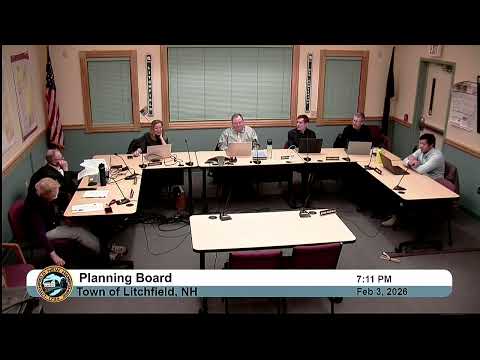
The Litchfield Planning Board spent the bulk of its Feb. 3 meeting reviewing Chapter 3 (Natural Resources) of the draft town master plan and agreed to share the draft with the Conservation Commission for detailed review and comment ahead of a public hearing.
Jay Car of the Northern Regional Planning Commission (NRPC) summarized that many recommendations in the chapter came from a conservation plan adopted roughly two years ago; the board’s task was to identify items needing correction, clarification or stronger language. "A lot of those are in here except for ones that obviously needed to be updated or changed in some way," Car said.
Board members focused on several recurring themes: preserving farmland and rural character, whether to change density requirements or open-space development yield calculations, protecting priority wildlife habitats and corridors, and strengthening shoreline and buffer protections for surface waters. Members raised the practical limits of local regulation — for example, tree-protection ordinances exist in some towns but might exceed the town’s regulatory reach — and discussed whether the plan should be directive or guidance-focused.
The board flagged specific technical items for correction or updating: several typographical errors, dead links in the online document, and dated NRPC source material labeled as 2021. Members also questioned references to local wells (noting the Daron/Dera well described as having a capacity of 100 gallons per minute and that some wells are not in active public use) and asked staff to verify whether language about water supplies and testing thresholds remains current.
Car and board members also addressed water-quality concerns. The draft identifies nutrient loading as a principal cause of algal blooms at Dera Pond and Nessen Keg Brook; board members discussed shoreline buffers, state shoreline protection requirements, and the difficulty of enforcing fertilizer restrictions on private lawns.
Next steps: the board will forward the chapter to the Conservation Commission for its meeting this week and collect suggested edits (typos, dead links, dated data) before scheduling a public hearing for the revised chapter.