Get Full Government Meeting Transcripts, Videos, & Alerts Forever!
Get email alerts on the Sb1123 Ordinance topic
No spam. Unsubscribe anytime.
Orinda planners recommend council limit SB 1123 subdivisions and bar ADUs on starter‑home parcels
Summary
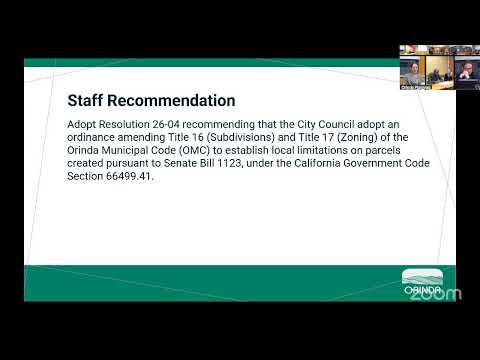
Staff told the commission SB 1123 (the Starter Home Revitalization Act) allows ministerial up to 10‑lot subdivisions but the city can exercise local discretion on sale/lease restrictions, subsequent SB9 splits and ADU allowances; the commission unanimously recommended City Council adopt an ordinance codifying sale/lease enforcement, prohibiting later SB9 splits, and banning ADUs on lots created under the act.
Associate Planner Darren Hughes gave a highly detailed presentation on the Starter Home Revitalization Act (referred to in staff materials as SB 1123) and how it interacts with existing state laws for accessory dwelling units (ADUs) and SB9 urban lot splits. He told commissioners the law allows ministerial subdivisions of up to 10 lots (and up to 10 units) on eligible parcels and that local jurisdictions have limited discretion over several implementation choices.
Hughes emphasized the ordinance the planning commission was being asked to recommend would use the limited local discretion allowed by state law to (1) enforce sale and lease restrictions in the state statute, (2) prohibit subsequent SB9 urban lot splits on parcels created under the starter‑home act, and (3) prohibit ADUs and junior ADUs on parcels created under this act. "We have to allow parcels to be as small as 1,200 square feet," Hughes said, describing statutory parcel‑size minimums and state limits on local floor‑area and parking requirements.
Hughes and commissioners discussed practical constraints in Orinda — notably fire hazard severity zones and topography — that will limit where the law can be used. Staff showed that many housing‑element parcels exceed the law’s 1.5‑acre eligibility cutoff and that roughly 50 parcels under 1.5 acres and outside the very‑high fire‑hazard zone could qualify in principle; staff also said the city has one active SB 1123 application and two prior inquiries in the last six months.
After questions about evacuation‑route policy and whether a blanket prohibition along evacuation corridors is legally defensible, commissioners agreed to move forward with the proposed local ordinance language that codifies sale/lease restrictions, prohibits further SB9 lot splits of starter‑home parcels, and bars ADUs on subdivided starter‑home lots. The commission voted unanimously to adopt Resolution 26‑04 recommending City Council consider the ordinance; staff told commissioners the ordinance would likely go to council in June for consideration.
What happens next: the commission’s recommendation forwards proposed ordinance 26‑05 to the City Council for its consideration (anticipated in June). Staff will continue work on adjunct policy tools such as fire‑area/evacuation‑route guidance and a permit‑tracking flag to ensure parcels created under the act are monitored for compliance with state sale/lease restrictions.