Get Full Government Meeting Transcripts, Videos, & Alerts Forever!
Get email alerts on the Blanket Certificate Program topic
No spam. Unsubscribe anytime.
FERC proposes major updates to blanket certificate program to speed natural gas projects
Summary
FERC voted unanimously to advance a notice of proposed rulemaking that would raise cost caps and expand eligible activities under its Section 7 blanket certificate program, aiming to streamline permitting while adding disclosure and rate protections for customers.
The Federal Energy Regulatory Commission on Tuesday advanced a notice of proposed rulemaking that would substantially expand and modernize its Section 7 blanket certificate program for natural gas projects, arguing the changes will speed construction while keeping environmental and ratepayer safeguards in place.
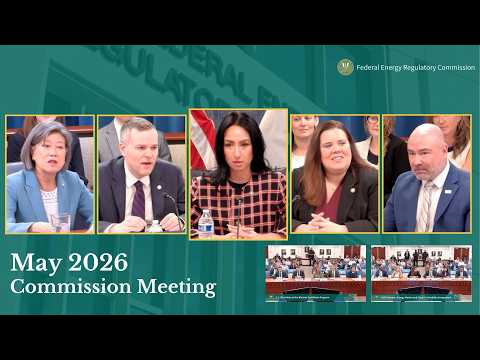
The commission voted unanimously on the consent agenda, which included the C1 notice, after commissioners discussed the proposal at the May 2026 open meeting. The notice would roughly double several cost thresholds used to determine which routine pipeline and related projects may proceed without case-specific authorization and would adopt new annual adjustment methods and reporting requirements.
"We are taking a historic step for our country towards massively accelerating development of the natural gas infrastructure," the Chair said in opening remarks, framing the package as an effort to streamline permitting and reduce delay.
In a staff presentation, Danielle Ellitz of the Office of the General Counsel summarized the key elements of the NOPR. Among the specific proposals are increasing the automatic-authorization cost cap from $14.5 million to $30 million and the prior-notice cap from $41.1 million to $86 million; adopting the Handy-Whitman index instead of the GDP price deflator for annual adjustments; extending in-service deadlines from one year to two; removing cost caps for certain infill or fence-line compressor expansions and for some receipt points; and tightening landowner notification and public disclosure rules, including requiring disclosure of project purpose and beneficiaries.
Ellitz told commissioners the proposal retains core environmental compliance obligations, including requirements to comply with the Endangered Species Act and the National Historic Preservation Act, noise limits near sensitive areas, and wetland and erosion controls.
Commissioners pressed staff on rate impacts and oversight. "That requirement is intended to protect shippers and ratepayers that may not necessarily benefit from the project," a staff presenter said when asked how disclosure of project beneficiaries would protect customers. The NOPR would also allow incremental rates for some prior-notice projects and require applicants proposing rolled-in or existing-system rate treatment to provide evidence that a project benefits existing customers.
Several commissioners underscored the increase in construction costs since the last major update and the commission's intent to focus staff resources on projects with greater potential environmental effects. Commissioner C said the record showed the median cost per inch-mile of pipeline construction rose roughly 250% from 2006 to 2024, supporting a need to update thresholds.
The vote recorded during the consent agenda included electric items E1–E9, gas item G1, hydro item H1, and certificate items C1–C5. Commissioners Lassert, Chang, C, Rosner and the Chair recorded affirmative votes, carrying the consent agenda unanimously.
Next steps: the NOPR solicits public comment on the analytical basis for the cost-limit increases, the method for annual adjustments, rate and accounting practices for projects charging transportation rates, protest procedures for prior-notice projects, the scope of activities eligible for automatic authorization, and the environmental information (including air quality and noise) to be required for compressor station expansions. The rule is a proposed action; it does not itself change the statute or finalize rate treatment until the commission issues a final rule after the comment process.
Proper names and authorities referenced in the discussion include the Natural Gas Act (section 7) and the Federal Energy Regulatory Commission. The staff docket will collect comments and supporting analysis before the commission considers any final action.