Get Full Government Meeting Transcripts, Videos, & Alerts Forever!
Get email alerts on the Crisis Care topic
No spam. Unsubscribe anytime.
King County: crisis care levy on track; Seattle center at 1145 Broadway planned for late 2027
Summary
King County officials updated the Seattle committee on progress implementing the 2023 crisis care levy, reporting early results from the Kirkland site, higher-than-expected Medicaid reimbursements and planning status for the Seattle (1145 Broadway) crisis care center with community engagement and safety work planned ahead of a late-2027 opening.
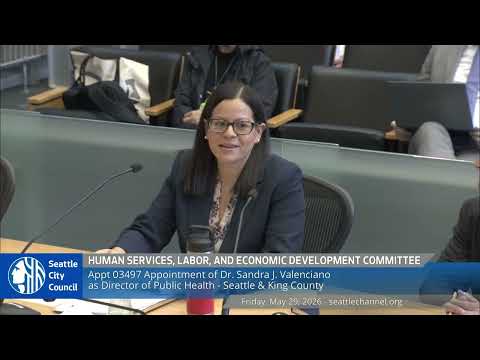
King County Department of Community and Human Services officials told the Seattle City Council's Human Services committee on May 29 that the voter-approved 2023 crisis care levy is advancing toward implementation and that the Seattle central crisis care center is planned to open in late 2027 if permitting and construction proceed on schedule.
Asha Venkatraman (municipal relations and community engagement manager), Katie Rogers (chief of staff, DCHS), Kelly Tong (Bridal/Crisis Care Center business operations manager) and Danille Bessemer (interim deputy director, behavioral health and recovery) presented the county's clinical model, early performance data and community engagement plans.
The county said the levy is intended to provide about $1.1 billion over nine years to build a regional network of five crisis care centers, restore residential treatment beds lost since 2018 and invest in the behavioral-health workforce. Each crisis care center is designed with three components: an urgent-care front door, a 23-hour observation unit for rapid stabilization, and a licensed crisis stabilization unit (CSU) offering up to 14 days of residential treatment as clinically appropriate.
The Kirkland Connections site opened in August 2025 and is funded through levy dollars; county staff reported that between January 2025 and March 2026 the Connections site recorded roughly 3,300 unique individuals over about 5,400 visits and 7,071 total first-responder drop-offs, with first-responder handoffs averaging 7–9 minutes. Staff said about 50% of visits were voluntary self-presentations and about 40% of visits involved first-responder drop-offs.
County presenters said the levy covers nonbillable operating costs (transportation, pharmacy, laboratory) and that the department took a conservative assumption of 40% Medicaid reimbursement when modeling levy finances; actual reimbursement to date has been closer to 55%, which the county said improves levy sustainability and projects a positive fund balance over the levy period.
On the Seattle site at 1145 Broadway, the county said it selected Connections Health Solutions as the operator, purchased the building into county ownership and has selected an architect to begin design work. The timeline calls for design and renovations through 2026 and construction in 2027, with a goal of certificate of occupancy and opening in late 2027, subject to permitting and land-use approvals. The county said it is considering a co-located 16-bed residential treatment facility and will release capital and operations RFPs later this year.
As part of local agreements tied to the site, city and county representatives noted conditions in a letter of support from the mayor: a Crime Prevention Through Environmental Design (CPTED) analysis to be conducted with Seattle Police Department (site walk planned for July/August), a "good neighbor" policy and community agreement, launch and safety planning, and the creation of a community advisory group. County staff said $3 million was allocated last year to support the advisory group and some of the conditions; they also cited a $500,000 one-time item in the human services budget that could be available to support launch-related recommendations.
County speakers described ongoing community engagement (more than 100 conversations in 2025), planned public events (a virtual community meeting on June 10, a community conversation at the site on July 21) and educational tools for local businesses (how to respond when someone appears to be in crisis, call 988). Staff said they would work with the city on CPTED recommendations and with the operator on a good neighbor agreement and a community advisory council that includes local providers and elected officials.
Committee members asked about resources for implementing CPTED recommendations and the stability of Medicaid reimbursement assumptions; county staff said funding sources are identified for some launch conditions and that they will follow up with additional analysis regarding reimbursement projections. The county emphasized that the crisis care model is intended to reduce reliance on emergency departments and police by offering a low-barrier alternative for people in behavioral-health crisis.
The county will continue community outreach and move into permitting and construction planning phases ahead of a late-2027 target opening for the Seattle central crisis care center.