Get Full Government Meeting Transcripts, Videos, & Alerts Forever!
Get email alerts on the School Referendum topic
No spam. Unsubscribe anytime.
Berkeley Heights presents two-question $50 million school referendum; architects say question one is tax neutral
Summary
At a Feb. 3 council meeting, Solutions Architecture principal Frank Msino outlined a two-question March 10, 2026 referendum for Berkeley Heights Public Schools that would fund district-wide facility upgrades; question one is presented as tax-neutral while question two would add an estimated $250.37 per year to the average homeowner.
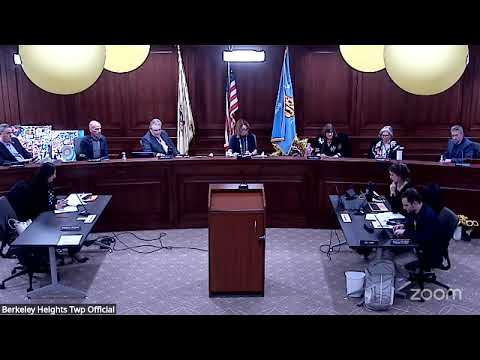
Frank Msino, principal and founder of Solutions Architecture, told the Berkeley Heights council and residents on Feb. 3 that the school district will ask voters on March 10, 2026, to approve a two-question referendum to fund districtwide facilities upgrades.
Msino said the referendum bundles roughly $50 million in gross projects across two ballot questions. "This referendum is aimed at meeting not only the needs of today but also tomorrow," he said, describing priorities that include media center renovations, science and STEM lab upgrades, security and technology improvements, roof and mechanical system replacements, and site/parking work.
The presentation separated the work into a $21.2 million question one and a roughly $29.1 million question two. Msino said the district has been approved for about $16.8 million in state debt-service aid across both questions; question one’s $21.2 million gross cost would be reduced by roughly $7.1 million in state aid to a net of about $14.2 million. Using the district’s financing assumptions (4.15% interest over a 20-year bond), he said question one would result in a net zero tax increase for the average assessed home (stated as $318,947).
By contrast, Msino estimated question two would raise about $250.37 per year on the average assessed home if voters approve it. "If question one passes one more yes vote than no vote, then question two is decided by its own majority vote," he said, stressing that question two is contingent on question one’s passage.
Msino also described schedule and budget safeguards: New Jersey practice is to reserve detailed design until after a referendum passes, he said, to avoid upfront design costs that might be wasted if voters reject the measure. The planning team built escalation and contingency allowances into cost estimates and said the aim is to bid early projects under budget to create surplus for later years.
In a public Q&A residents pressed for details. One asked, "So should both of these questions fail, the district will continue to do what it can out of the capital budget," to which Msino replied that projects would be re-evaluated and scaled or repriced and that state aid would be forfeited if work were done outside a referendum. Another resident asked for clarity on when the tax increase would appear; Msino said the tax impact likely would not kick in until 2027 because bonds are sold after passage and the schedules are set by finance staff.
Supporters and skeptics spoke during the citizens hearing. "I personally only see infrastructure on this list," resident Xander Price said in favor; John McGuire said he remained undecided and wanted assurances that budgets would better align with academics if the district asks voters to approve large spending. The district directed residents to the district website for a tax calculator and to an email address for questions.
The district’s presentation materials, estimated costs, and the tax-impact calculator are posted on the district website, Msino said. The referendum’s March 10 date was chosen to allow the district to take advantage of expiring debt service and state aid. If question one fails, Msino said, question two becomes moot and any approved debt-service aid tied to the referendum would be forfeited.
The council meeting moved on to the regular agenda after the presentation; no formal local action on the referendum was taken at this meeting. The architect and district staff asked residents to submit questions by email and said they would publish answers in the FAQ on the district website.
What’s next: The referendum will appear on the March 10, 2026 ballot. Residents who want detailed, parcel-specific estimates can use the district’s online tax-impact calculator or contact the district for clarifications.