Get Full Government Meeting Transcripts, Videos, & Alerts Forever!
Get email alerts on the Sewer Project topic
No spam. Unsubscribe anytime.
Paradise council pauses sewer EIR after site losses as residents press for STEP alternative
Summary
Town staff said two candidate treatment sites were removed—owner objection at Skyway Crossroads and geotechnical infeasibility at Mediaway—putting the subsequent EIR on hold as the town vets new sites and considers contingencies; public speakers urged evaluation of STEP/low‑pressure systems as lower‑cost, scalable options.
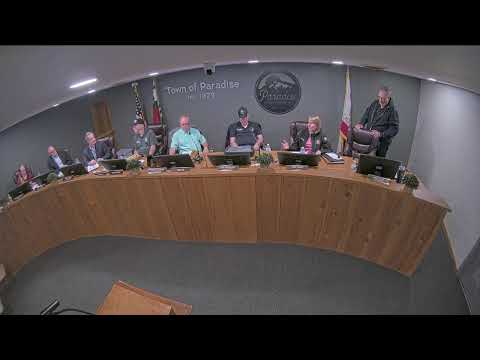
Mayor Steve Crowder and town staff opened the Paradise Sewer Project update with a status report that placed the project closer to construction but paused the environmental review stage.
Assistant Town Manager Mark Maddox told the Town Council the project has been re‑scoped toward a local hybrid gravity/low‑pressure collection system with aerated lagoon treatment and a land‑discharge percolation/evaporation pond option, but two candidate wastewater treatment facility sites were removed from consideration. "That site has been removed from evaluation due to community feedback and property owner objection," Maddox said of the Skyway Crossroads parcel, and he added that geotechnical work at the Mediaway (Skyway South) site "revealed a very shallow rock lava cap and high groundwater, which renders the site infeasible for a wastewater treatment facility site using percolation ponds for effluent discharge." As a result, the town’s subsequent EIR is on hold while staff evaluates new parcels along Skyway, Neal Road and Clark Road.
The presentation triggered extended public comment and technical pushback from residents and outside experts. Cliff Jacobson, who has long advocated for STEP (septic tank effluent pump) systems, urged council to commission a full technical presentation and field visits to existing STEP installations before committing to a gravity‑based or hybrid design. "These systems work. They're cost‑effective, they're easy to put in, and I hope that we take a really hard look at it," Jacobson said, adding that STEP systems can be scaled incrementally and require lower ongoing maintenance.
Melissa Schuster, another member of the public, asked the town to trial a STEP system in the proposed downtown phase‑one service area. "Treating effluent only is much less to collect, much less to treat, and easier to discharge," she said, arguing a small pilot for the 88‑lot walkable downtown could be tested and later expanded if successful.
Town staff acknowledged the submissions and letters the council had received, including a joint March 24, 2026 letter proposing STEP/Title 22 recycled water return and a request for independent technical review. Maddox said staff is working through a defined next step: additional geotechnical testing at three candidate sites (Clark Road, Middle Skyway and lower Skyway) and contingency planning for surface‑water discharge or beneficial reuse if soils and groundwater prove unsuitable for land discharge. "Our public draft of the subsequent EIR is on hold pending review of new wastewater treatment facility sites," he said.
Council and commenters repeatedly pressed for financial and operational modeling before major commitments. Residents raised concerns about up‑front costs, subsidies for early hookups, and long‑term operation and maintenance (O&M) burdens. One speaker requested computer modeling to show break‑even scenarios, user counts needed to cover O&M and the effect of partial hookups over time; Maddox said conceptual cost ranges and pending grant applications ($35–$75 million range in pending applications) make definitive rate forecasts premature but that the town can return with scenario analyses.
What’s next: staff said it will perform the additional geotechnical testing authorized on Clark Road parcels and continue collection system design with HDR and Corollo Engineering as owner’s agent and designer. The council heard multiple requests from residents and technical advocates to obtain an independent review comparing STEP, low‑pressure and hybrid alternatives; Maddox said staff can pursue an independent response and provide an updated conceptual rate analysis for council consideration prior to certifying the subsequent EIR.