Get Full Government Meeting Transcripts, Videos, & Alerts Forever!
Get email alerts on the Climate Element topic
No spam. Unsubscribe anytime.
Clark County planner outlines draft climate element; commissioners press for incentives for historic buildings
Summary
Clark County planner Jenna Kay presented a draft climate element required by House Bill 1181, explaining the county must add greenhouse-gas-reduction and resilience policies to its comprehensive plan. Commissioners urged staff to consider incentives and funding paths to help owners of historic properties make retrofits.
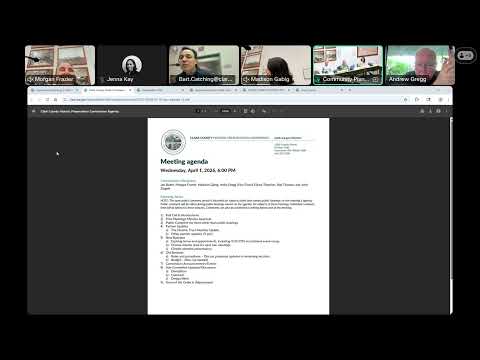
Jenna Kay, a long-range land use planner with Clark County Community Planning, told the Historic Preservation Commission on April 1 that House Bill 1181 (signed in 2023) requires the county to add a climate element to its comprehensive plan that both improves resilience to climate hazards and reduces greenhouse-gas emissions.
The draft climate element outlines 32 goals grouped into topics such as health and well-being, green jobs, ecological stewardship, transportation and land use, building and energy, and waste management. "This climate element has to do two things," Kay said: help the county improve resilience to climate hazards and help reduce greenhouse-gas emissions, with an explicit requirement to prioritize actions that benefit overburdened communities.
Why it matters: The proposed policies could affect historic preservation in Clark County by encouraging adaptive reuse, green-building incentives, and consultation with tribal governments on culturally important sites. Kay highlighted two provisions of particular relevance to preservation: a policy to consult tribal governments and culturally specific groups to identify sites threatened by climate impacts, and policies to incentivize green building and adaptive reuse of existing buildings.
Commissioners pressed staff on implementation. "The best way to reduce greenhouse gas is to use the best practice of reusing buildings, existing buildings, and not building new buildings," said Commissioner Morgan Frasier, who asked whether the draft includes incentives for homeowners and owners of historic properties. Kay replied that policy approval by the county council is the first step and that implementation details—including whether incentives will be funded—will be developed afterward: "There27s a lot to figure out. We are expecting some funding, but how much, what we can use it for, we still don27t know those details."
Commissioner David asked whether the policies include specificity for embodied carbon, seismic upgrades, or other retrofit measures for historic structures. Kay said such technical details are likely to be addressed during implementation and code- or program-level steps, and she indicated the commission would be consulted when policies intersect with historic-preservation concerns.
County staff described the project timeline as a five-phase process that began in early 2024 and produced a draft climate element now ready for the county27s adoption process. Kay said planning commission and county council hearings are expected in late summer or fall 2026, and the public will have opportunities to provide written comments or verbal testimony at those hearings. She provided a project web page and invited commissioners to sign up for updates.
The presentation and exchanges make clear that the draft element sets broad policy direction; the commission and staff will need to work through implementation details, funding availability, and potential incentives before specific programs that affect historic properties are finalized.