Get Full Government Meeting Transcripts, Videos, & Alerts Forever!
Get email alerts on the Active Transportation topic
No spam. Unsubscribe anytime.
Larkspur commission backs application for Redwood Highway separated bike path and sidewalks
Summary
The Parks & Recreation Commission gave staff its concurrence to apply for a state Active Transportation Program grant to build a curb‑separated two‑way cycle track and new sidewalks on Redwood Highway; the roughly $4 million project would include a new signal at the Trader Joe’s driveway and requires grant approval to proceed.
Larkspur City public‑works staff won tentative approval from the Parks & Recreation Commission to apply for a state Active Transportation Program (ATP) grant to build a separated two‑way (class‑4) cycle track and new sidewalks along Redwood Highway.
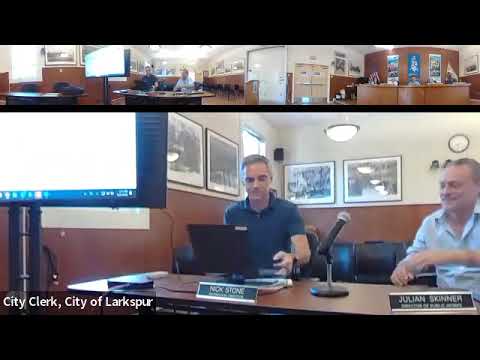
Public Works Director Julian Skinner told the commission the project, included in the city’s Bike & Ped Master Plan and capital improvement program, would extend the city’s bicycle network to meet the northern terminus of the North‑South Greenway and add sidewalks along mobile‑home frontages. Skinner said the schematic plan calls for reconstructing the east‑side sidewalk, moving the curb out, and installing a 10‑foot, curb‑separated two‑way cycle track with green crosswalk markings where the path crosses driveways. The project would also include a full traffic signal at the main Trader Joe’s/Cost Plus driveway to allow safe bike and pedestrian crossings.
"This is a project that's been in our CIP, but it's not funded," Skinner said, noting staff has applied for the ATP three previous times and will make a fourth application this cycle. He told commissioners the Transportation Authority of Marin is funding the grant application work so the city’s out‑of‑pocket cost for the submittal is limited to staff time. Skinner estimated the total project cost at about $4 million and said preparing an ATP application typically requires roughly $60,000 of effort; TAM agreed to fund that work this cycle.
Commissioners asked how the project addresses flooding and sea‑level concerns after recent king‑tide inundation. Skinner said CIP projects consider sea‑level rise and interim flood measures, but larger protective actions require regional planning and multi‑agency investments. He also confirmed the signal at the primary driveway will be a full vehicle signal with pedestrian heads and that coordination and traffic studies will be required to prevent freeway backups.
Skinner described grant competitiveness: ATP is highly competitive and projects serving formally designated "communities of concern" earn scoring advantages. Larkspur lacks those automatic points, Skinner said, but he argued the project’s multi‑jurisdictional connections and safety features make it competitive. Applications are due at the end of June; staff asked the commission for formal concurrence to submit the application. A motion to proceed passed after a second.
If the city wins the ATP award, staff said it will run public workshops to refine schematic plans, work through driveway and right‑of‑way details, and move to engineering and construction procurement. If the grant is not awarded, staff said the city will evaluate other large funding sources but will avoid applying for smaller grants that cannot be combined to deliver the roughly $3–4 million project.
The commission’s vote provides staff authorization to submit the ATP application; the project requires grant approval before construction can begin.