Get Full Government Meeting Transcripts, Videos, & Alerts Forever!
Get email alerts on the School Facilities Referendum topic
No spam. Unsubscribe anytime.
Consultant: Survey finds community split; administration recommends scaled, expandable Otsego high school and $350M package
Summary
A School Perceptions survey of 4,859 respondents found pluralities favoring a long‑term high‑school solution but no weighted majority; administration is recommending a core 1,900‑student facility built to 1,500 capacity plus an E‑8, education center, CTE and safety upgrades in a roughly $350 million package, with an estimated tax example of about $35/month on a $400,000 home.
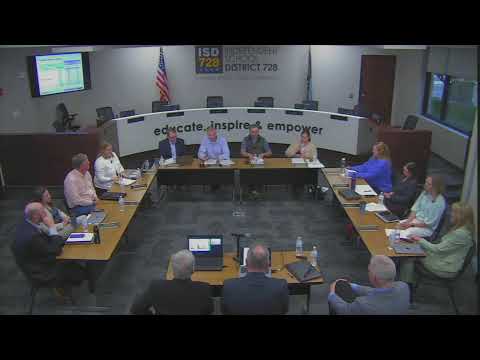
A consultant’s community survey and a subsequent administration recommendation left ISD 728 board members weighing whether to put a major facilities package on the ballot.
School Perceptions consultant Darren Sievers told the ISD 728 board on May 19 that 4,859 people responded to the district’s community survey and that the firm’s weighted projection—counting undecided respondents conservatively as no—would yield about 47.5% “yes” on a long‑term, core‑1,900/initial‑1,500 high‑school option and about 36.1% for a smaller 1,300 option. Sievers said the survey’s margin of error for the resident sample is roughly ±1.44 percentage points.
The result, Sievers said, shows “permission” to consider a new Otsego high school but not a clear, weighted majority to pass a full ask on the ballot as drafted. “Our data’s 94% predictive of vote,” he added, describing the firm’s conservative modeling approach.
Why it matters: district staff and a citizen task force have documented steady enrollment growth and capacity pressures in the southern part of the district. Administration presented a draft capital package intended to solve capacity needs for the next decade and reduce the need for repeated asks to voters.
What the administration recommended: Cabinet members Joe and Corti outlined a multi‑component proposal that would include a new Otsego high school built on district‑owned land in West Otsego (174 acres) with core infrastructure sized to 1,900 students but initially configured for 1,500 students so the building can be expanded later. The package also includes an E‑8 facility in eastern Otsego (district‑owned 38 acres), a new consolidated education center for specialized and alternative programs, roughly $16 million for career and technical education upgrades across schools, safety and secure‑entry projects at middle schools, and other repairs and priorities. Staff put a preliminary total bonding estimate at about $350 million and an operating capital projects levy around $9 million.
Cost examples and fiscal framing: Staff offered an example tax impact: approximately $35 per month on a $400,000 home (about $419 annually) including principal and interest under conservative assumptions. Administrators and the consultant emphasized that costs rise with delay—Sievers and staff cited construction‑cost inflation of roughly 5–10% per year as a planning consideration.
Board concerns and tradeoffs: Board members pressed staff and the consultant on three central tradeoffs: (1) whether to ask for a larger, longer‑term package now or phase projects to lower immediate tax impact; (2) how much design and program scope (auditorium, athletics, glass/furnishings) could be trimmed without undermining the long‑term plan; and (3) whether reductions in scope would increase support among voters who said they did not trust district fiscal management. One board member said, “I honestly think it’s way too much. I think that our communities can’t afford it right now,” (attributed in the meeting as a board member); administrators answered that lowering the ask typically raises support but risks future higher costs because of inflation.
Next steps: The board set a May 26 special meeting to consider how to proceed; staff and School Perceptions agreed to provide municipal‑level breakdowns of support (top five or six municipalities) and a short recorded explanation of the survey results for distribution to the public. Administrators emphasized they will provide factual outreach materials and that formal action (a resolution authorizing a referendum) would occur at a later meeting if the board chooses to move forward.
What remains uncertain: The survey showed a plurality preferring the larger, long‑term high‑school solution when options and tax impacts were explained, but Sievers cautioned the underspecified ‘unsure’ group did not reliably shift to ‘yes’ in post‑COVID experience; staff framed the current draft as a compromise to respond to the survey’s mix of long‑term preference and tax sensitivity.
The board did not vote on a referendum tonight; it passed a consent agenda and will revisit the proposal at upcoming meetings. Public comment opportunities will be available in future meetings as the board considers next steps.