Get Full Government Meeting Transcripts, Videos, & Alerts Forever!
Get email alerts on the Tree Ordinance topic
No spam. Unsubscribe anytime.
Marvin planning board considers tougher tree protections, buffer rules and soil standards
Summary
Staff and board members debated revisions to Article 11 (tree and landscape) of the Marvin Development Ordinance, covering preservation percentages, heritage-tree mitigation, soil/backfill requirements, buffer/screening options and enforcement limits; staff will draft language for March.
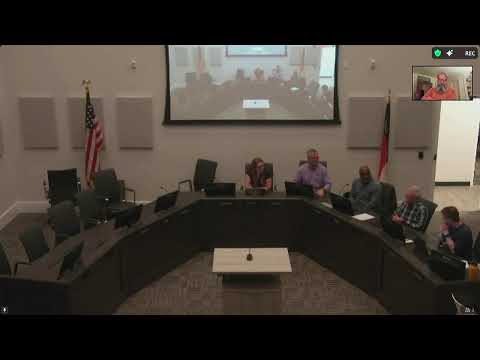
Marvin planning staff and board members spent the bulk of a joint Feb. 16 meeting debating proposed changes to Article 11 of the Marvin Development Ordinance, aimed at strengthening tree preservation, clarifying mitigation for removed trees and tightening construction practices such as topsoil handling.
Planner staff presented a summary of existing rules and possible amendments, saying the town already requires preservation percentages tied to acreage and a 25‑foot perimeter preservation strip, but cannot categorically prohibit clearcutting. Staff described options to define 'heritage' or specimen trees by diameter (for example, 36 inches) and to impose higher mitigation fees or fines if developers remove such trees.
Staff also emphasized an existing construction standard that landscape yards must be backfilled with original soil and tilled 8–12 inches; they proposed clarifying language so developers cannot sell topsoil removed during grading and must reuse adequate topsoil in backfill. “The entire landscape yard must be basically organic amendments tilled to a depth of 8 to 12 inches,” staff noted when pointing to current text and said the ordinance could be clarified and referenced in subdivision rules.
Board members debated tradeoffs between preserving canopy and providing year‑round screening for neighbors. Some members said berms, evergreen plantings and structured buffers produce more consistent sight‑screening than preservation of interior canopy alone; others warned that some screening approaches can conflict with canopy goals and that each site will require case-by-case evaluation.
On enforcement, staff recommended leaning on conditional‑zoning approvals to attach site‑specific tree protections and mitigation requirements. They said tree surveys (using diameter thresholds such as 4 inches for understory or higher thresholds for canopy trees) could accompany rezoning and conditional applications so staff and the county urban-forest reviewer can assess quality and health.
The board also discussed regulation of individual property owners who cut trees outside a development context; staff said state law limits some municipal authority and that nuisance provisions can be used in certain invasive-species or severe cases. Members asked staff to draft clearer ordinance language, stronger mitigation for heritage-tree loss and options for buffers and screening; staff plans to return to the planning board in March with proposed text.
Next steps: staff will draft ordinance edits and mitigation options and return to the planning board for additional review in March; conditional‑zoning language may be used to tailor protection to individual developments.