Get Full Government Meeting Transcripts, Videos, & Alerts Forever!
Get email alerts on the Municipal Budget topic
No spam. Unsubscribe anytime.
Pompey Town Board closes budget hearing, approves 2026 salaries as staff warns of a roughly 7.3% tax rise
Summary
The Pompey Town Board closed a public hearing on the proposed 2026 budget, approved specified town officer salaries, and heard staff warn of a projected 7.3–7.4% property tax increase driven by lower non-property revenues and rising costs; a resident pressed for more detail on repeatedly listed “contractual” line items.
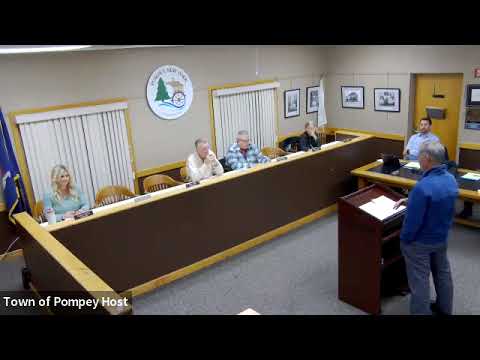
Pompey Town Board members closed a public hearing on the proposed 2026 budget and approved the salaries for several town officers after a presentation from town staff and questions from a resident.
Town staff member Jim gave an overview of the draft budget, telling the board the plan faces “a challenging budget” year as revenues outside property taxes fall and costs rise. “We’re looking at as of right now about a 7.3–7.4% increase to property taxes,” Jim said, framing that change as the net effect of lower interest income, declining mortgage-tax receipts and shrinking cable-franchise fees paired with higher costs such as a roughly 10% rise in general liability insurance and a 24% increase in New York State retirement costs (about $14,000 to the town). He also flagged utility bills (National Grid) rising about 15% and a $14,000 increase for enhanced patrols.
The presentation noted special-district impacts as well: the largest special-district change cited was the fire district’s budget rising from $820,000 in 2025 to $926,635 for 2026, about a 13% increase.
The hearing drew a public comment from resident Jim Goer, who asked the board for clearer line-item detail. “The word ‘contractual’ is in the budget dozens of times without any detail as to what is being contracted,” Goer said, asking the board to provide a supplemental breakdown because he and other residents could not tell what large contractual totals cover. Staff responded that New York State prescribes account groupings (personnel services, equipment, contractual) and that ‘contractual’ includes a range of non-personnel, non-equipment expenses (examples given: office supplies, travel and conferences, software, mileage and ZBA expenses), and that staff would try to improve public disclosure where possible.
Goer had also questioned sizable contractual totals in the highway fund: staff confirmed the highway fund shows planned transfers and expenditures and identified $210,000 being drawn from the highway fund this year and $30,000 from the general fund (about $240,000 total) to smooth near-term tax pressure. Staff estimated the highway fund’s balance would remain in the neighborhood of $1.0–1.4 million after those transfers. Board discussion emphasized developing a multi-year capital plan and vehicle-rotation strategy to manage expensive equipment purchases (examples cited in discussion included trucks approaching $200,000 and other pieces of equipment near $400,000).
On enforcement funding, the board confirmed the $14,000 police-line increase pays for enhanced enforcement shifts (a four-hour minimum at an hourly rate). A resident noted that more enforcement might suggest higher fine revenue; staff replied that most court fine revenue is remitted to the state, limiting local revenue gains from increased citations.
After the hearing the board moved to approve specified 2026 salaries: Supervisor $16,000; Highway superintendent $80,730; Town clerk $42,500; Town justices $13,000 each; and four town board members at $4,705 each. A motion to approve those salaries was made, seconded and carried; the board closed the public hearing. Board members indicated the final version of the full budget would be adopted at a later meeting after any final adjustments.
The meeting adjourned following the votes.