Get Full Government Meeting Transcripts, Videos, & Alerts Forever!
Get email alerts on the School Bond topic
No spam. Unsubscribe anytime.
Board sees narrow path to pass high-school bond after positive messaging in survey
Summary
A March 2026 tracking survey commissioned by Modesto City Schools showed average voter support near 56.2% for a proposed high-school bond extension — above the 55% Prop 39 threshold after positive messaging — while trustees requested clearer ballot language, more project detail and stronger outreach plans.
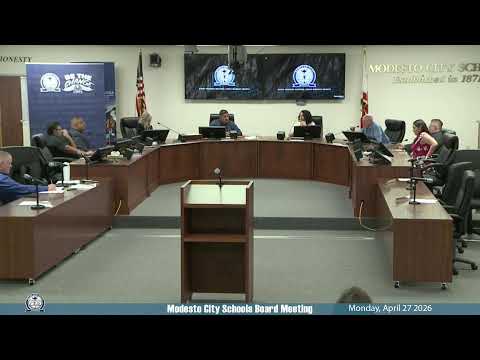
Modesto City Schools trustees on April 27 reviewed results of a March 16–29 tracking survey showing a potential path to pass a November 2026 high-school bond, but raised questions about ballot wording, survey reliability and outreach capacity.
District consultant (identified in the transcript as "Mr. Tims early") told the board researchers identified about 95,000 likely voters and completed 703 interviews, reporting a margin of error of plus or minus 3.68 percent. He said initial, unaided support for an additional high-school bond was 51.3 percent, but after respondents heard positive messaging support rose to 59.3 percent; the consultant reported an averaged figure of 56.2 percent across neutral, positive and negative prompts. "We need 55% to have a Prop 39 successful bond measure," he said.
The consultant described one tested ballot phrasing that framed the proposal as an extension at a reduced rate: "extending the existing tax rate at a decreased $24 per $100,000 assessed value, providing approximately $14 million annually." He cautioned that voters "didn't trust" wording that implied a tax decrease and recommended the district refine language before moving forward.
Trustees pushed for clearer, more specific project lists and for explicit messaging about the tax impact. "I just don't want to be accused of being sneaky in saying…you're saying it's a decrease," said Trustee Masters, who asked for clarity that the proposed measure would substitute for expiring high-school debt. The presenter responded that the 2002 bond currently costs the average taxpayer about $79 and that the proposed measure is estimated to cost about $57 per year for the average homeowner, a point he said should be emphasized in outreach.
Trustee Lopez asked whether the new measure would be a substitution rather than an additional tax; the presenter said it was intended as a replacement for expiring high-school bonds so taxpayers would not see an increase in most cases. Trustees also asked which schools would be prioritized; the presenter and superintendent said all seven high schools would be considered at some level and that items such as athletics, performing-arts facilities and CTE (career technical education) classrooms would be eligible only if included on a final project list.
Several trustees expressed concern about the 2026 political and economic environment — including higher living costs, call screening and sharper voter skepticism — and urged the district to prepare a more robust and targeted outreach plan. One trustee said some traditional volunteer supporters (the presenters referenced MTA supporters) have indicated they might withhold participation unless contractual conditions are met, a factor trustees said could affect campaign capacity.
Fawn Peterson, chapter president of Modesto 007 of the California School Employees Association, urged the district to provide more specifics about which high-school projects the bond would fund before asking for union support.
The presenter outlined next steps: develop informational messaging and stakeholder outreach, draft a bond resolution and project list, present a first reading on May 18 and, if the board approves, consider adopting the bond resolution on June 8 and then move to an independent advocacy campaign.
The board adjourned to a closed session; no reportable action was announced on the record. The board previously noted that direction had been given to staff in closed session.