Get Full Government Meeting Transcripts, Videos, & Alerts Forever!
Get email alerts on the Budget topic
No spam. Unsubscribe anytime.
North Marion SD 15 budget update flags expiring PERS discount, enrollment decline and use of savings to balance next year
Summary
District finance presenter Kim told the board that an expiring PERS side‑account discount (June 30, 2027) and a modest enrollment decline are shrinking state funding; staff forecast using a portion of this year’s savings to balance the 2026‑27 budget and highlighted a projected $800,000+ bond payment gap in 2027‑28.
Kim, the district’s budget presenter, told the North Marion SD 15 board the district faces a “stable but just tight” fiscal outlook as it prepares the 2026–27 budget. She said state revenue forecasts released in March were more positive than earlier projections but slower job and wage growth could reduce income‑tax receipts that support school funding.
Kim explained the district is projecting a fall 2026 enrollment of about 1,525 students, down from the 1,581 used for the current year’s budget, and said that decline reduces the district’s share of the State School Fund. She noted a positive early sign—about 90 kindergarteners already enrolled for the coming year—but stressed enrollment projections remain cautious until counts are finalized.
The presenter highlighted two important fiscal details. First, state law and the biennial allocation produce only a modest increase in the district’s State School Fund share (Kim cited a 1.3% example figure tied to enrollment shifts). Second, changes to integrated‑plan grants allow the district to lock funding at the 2025–26 enrollment for the second year of the biennium, producing an estimated 4.1% increase in that specific grants pot that primarily supports staffing.
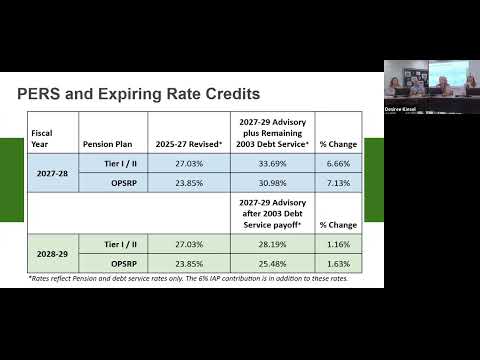
On pension costs, Kim said Senate Bill 849 provides a short‑term rate credit that reduced projected employer PERS rates for tier‑one and tier‑two employees from about 28.71% to roughly 27.03% for the current biennium. She warned that a separate PERS side account the district established with proceeds from early‑2000s bond issuances is scheduled to expire on June 30, 2027, removing a recurring discount. "That side account...the discount in rate is set to expire June 30 of 2027," Kim said, noting the timing creates a year (2027–28) when the district must make bond payments without the discount.
Kim gave a concrete example of the near‑term pressure: for 2027–28 the district expects to make over $800,000 in bond payments with no PERS rate discount, increasing employer pension costs for that budget year before the final bond is paid off in 2028–29 and rates are projected to drop again.
She also reviewed operational cost drivers: electricity costs that have increased roughly 60% in recent years and insurance premiums that Kim estimated have risen about 92%. Those increases, she said, outpace revenue and squeeze operating budgets.
Kim said the district is finishing the current year with a fund balance above budgeted levels—she discussed a $2.4 million example—but cautioned that the board will likely need to use some of those savings in next year’s budget to achieve balance. "If we end this year at a $2.4 million ending fund balance, I cannot balance a budget putting 2.4 million as next year's ending fund balance," she stated, adding staff will propose a budget that uses a portion of the savings and will present a proposed budget for board and public review.
On contracts and service delivery, Kim reported recent progress: a contract with the classified association is in place, licensed‑group negotiations have been productive, and the district is working to finalize non‑represented staff contracts. She also said the district has been authorized to work with First Student and is expecting a "significant reduction" in next year’s transportation cost increases, which staff identified as a known cost that will help the budget.
Kim closed by outlining next steps: budget committee meetings are imminent, staff will provide a budget message from Dan and present a proposed budget document with public comment opportunities, and if the budget is approved by the committee it will go to the board for adoption at the June 8 board meeting; a second budget committee meeting was noted for Monday, May 18 if revisions are needed.
Next steps: staff will present the proposed budget and supporting materials to the budget committee and the board, receive public comment, and return to the board in June for possible adoption.