Get Full Government Meeting Transcripts, Videos, & Alerts Forever!
Get email alerts on the Literacy Grants topic
No spam. Unsubscribe anytime.
State Board approves major literacy subgrants after heated debate over scope and recipients
Summary
The State Board of Education voted 4-3 to authorize year-three awards from the Comprehensive Literacy State Development (CLSD) funds, drawing criticism about concentrated funding, private recipients, and long-term accountability for statewide reading goals.
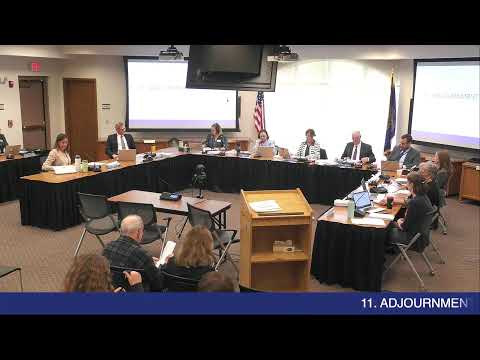
The State Board of Education voted on May 8 to authorize subgrants from the state's CLSD literacy program, a multi-year initiative funded with $55 million to expand evidence-based literacy instruction. The motion passed 4-3 (one member absent) after more than an hour of discussion about reach, equity and accountability.
Board member Elizabeth Tegmier said the grants represent a large investment and pressed staff for assurances that the use of funds aligns with the board'set goal for third-grade reading proficiency. "We were told we would be having all 23,000 of our teachers trained in evidence-based reading instruction," she said, expressing concern that current awards appear "too narrow to accomplish that." She noted turnover and timing concerns tied to agency staffing and the grant timeline.
NDE academic officer Allison Denbi defended the award process, saying all districts were eligible to apply and that 16 of 17 Educational Service Units (ESUs) applied as consortia, which together include roughly 158 districts or about 68% of districts and students in Nebraska. Denbi said the competitive first-year process, followed by renewals, was the grant design and that recipients must submit annual brief applications documenting progress. "All districts in Nebraska had the opportunity to apply," she said. Denbi described a multilayer review process with trained NDE reviewers and rubrics used to score applications.
Board member Sher(r)y Jones and others raised questions about private organizations appearing as recipients of CLSD funds. Denbi explained that allowable uses include early childhood activities and that in the early childhood space, certain nonpublic entities can be direct recipients; she said private entities on the award list (for example, the Buffett Early Childhood Center) are applying for allowable activities that serve children eligible under the grant.
Jamie's oversight and evaluation reporting were cited by NDE staff as producing evidence of effectiveness; however, some board members said they wanted stronger guarantees the funds would be spent to scale training and materials across more districts. Jones also pressed staff on expansion and whether NDE could open a new competitive round or reallocate unspent funds in future years.
The vote followed a split among members on philosophical and fiscal grounds. Board members who voted no argued grant selections concentrated funds among repeat recipients and called for a broader distribution or additional rounds to reach more teachers and districts. The motion passed by a 4-3 margin.
The board adopted the grants after hearing staff explanations of scoring priorities, which gave double weight to professional learning-driven applications and required distribution across birth-to-kindergarten, K-5 and grades 6-12 as set by federal CLSD guidance.
What happens next: NDE will proceed with contracting and disbursement to the identified subawardees and continue required federal reporting for the CLSD program.