Get Full Government Meeting Transcripts, Videos, & Alerts Forever!
Get email alerts on the Special Education Staffing topic
No spam. Unsubscribe anytime.
Teachers urge Scarborough School Board to address special-education staffing and safety concerns
Summary
Multiple teachers and building representatives told the Scarborough School Board that special-education staffing, training and supports are insufficient, citing frequent injuries to staff and requesting a district-funded review and program changes.
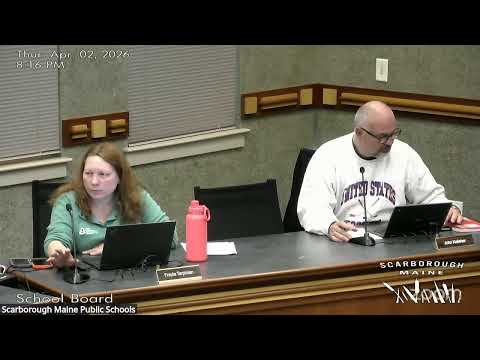
Multiple teachers and building representatives used the board’s public-comment period on April 2 to press the Scarborough School Board for immediate action on special-education staffing and safety.
"We are doing a disservice to our staff, our special education students and our mainstream students by ignoring these issues," said Sarah Kaplan, an English language arts teacher and secretary of the Scarborough Education Association, summarizing colleague feedback about understaffing, cancelled budgets and overwhelming paperwork.
Garrett White, a middle-school art teacher and SEA vice president, read survey responses that described staff as "exhausted, tapped out, done" and said educators report physical and emotional strain from supporting high-needs students.
Dylan White, a 24-year district employee who has worked in special education in multiple roles, recounted a classroom incident in which he said a student "slammed the door on my foot," resulting in what he described as "a non-displaced fracture of the cuboid bone" and six weeks in a boot. He urged the board to prioritize staff safety, training and supports.
David Pay, a social studies teacher and building representative, offered specific proposals compiled from members: hire a dedicated special-education instructional coach or liaison; increase leadership visibility and timely responses from administration; develop partnerships with local colleges for internship pipelines; adopt more competitive wages to recruit one-on-one staff; and provide more training and prep time for educators.
Board members did not take formal action during the meeting on the requests voiced in public comment. Several board members have earlier acknowledged looming budget constraints: the town council’s first reading of the town budget came in at 5.99 percent, and board leaders said difficult spending choices lie ahead.
Advocates in the room asked the board to fund investigations and program changes this spring so solutions can be considered before budget decisions are finalized. The board did not announce a specific next step during the April 2 meeting; the concerns raised will be part of forthcoming conversations by district leadership and the finance committee.