Get Full Government Meeting Transcripts, Videos, & Alerts Forever!
Get email alerts on the Housing Market And Constraints topic
No spam. Unsubscribe anytime.
Dover housing task force launches public outreach as consultants outline high prices, zoning and environmental limits
Summary
At an initial information session, Barrett Planning Group presented data showing very high single-family prices, a small subsidized housing inventory and zoning and environmental rules that limit housing diversity; the task force asked residents for input on priorities and trade-offs.
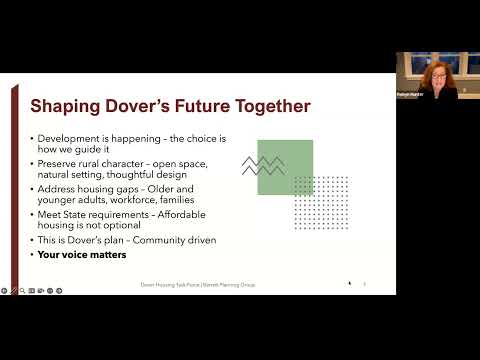
The Dover Housing Task Force held its first public information session where consultants from Barrett Planning Group presented a data-driven overview of the town’s housing market and regulatory constraints and asked residents for input on priorities and trade-offs.
Consultants said Dover’s population was about 5,930 (2024) and that the town’s housing stock is overwhelmingly single-family and owner-occupied. "The data we saw in 2025: the average median sales price for a single-family home was $1.6 million," John Charles of Barrett Planning Group said, summarizing poll results and sales data shared with attendees. The consultants also reported that Dover’s subsidized housing inventory stands at 2.82% — well below the state’s 10% guideline under Chapter 40B.
Why it matters: The combination of very high home values, a high share of long-held properties and regulatory and environmental constraints means fewer naturally affordable options and limited opportunities for multifamily development without major changes to local policy or infrastructure. "Most housing in Dover is single-family, and recent multifamily development has happened under Chapter 40B rather than through local zoning," a consultant explained, noting that the town’s local multifamily (RM) district exists in the bylaw but is not mapped, creating procedural barriers to developer-led multifamily projects.
The consultants walked through assessor and permit records, showing roughly 2,000 housing units in town and about 1,850 parcels assessed as single-family. They highlighted differences across value tiers: a "lower-cortile" of smaller, older lots that could be relatively more attainable still have high prices in Dover’s market, while "upper-cortile" properties are newer and more valuable. The Barrett team also described recent building activity, including a 34-unit rental development in 2023 of which 25% of units are deed-restricted as affordable.
Panelists emphasized technical constraints that affect siting and scale of development: lack of municipal sewer and public water requires on-site wells and septic systems and triggers wetlands and Title 5 setbacks. Tony, a consultant, described a local "perfect square" frontage rule and large minimum lot sizes that discourage compact housing and make narrow or irregular lots noncompliant under current zoning.
On funding and tools, the consultants noted Dover’s 2022 Housing Production Plan and said the town has not adopted the Community Preservation Act (CPA), which could provide local funding for housing preservation and creation. They encouraged residents to use the project website and upcoming forums to share ideas and priorities that will be used to shape a "toolbox" of feasible approaches for Dover.
The session closed with instructions about where to find slides and how to submit additional comments. The task force and Barrett Planning Group said they will hold additional outreach sessions, including at least one in-person meeting, and will post materials and summaries to the project webpage.