Get Full Government Meeting Transcripts, Videos, & Alerts Forever!
Get email alerts on the Roads And Conservation topic
No spam. Unsubscribe anytime.
Planning Board weighs private roads, conservation subdivision incentives and updated road standards
Summary
Hopkinton Planning Board members discussed the pros and cons of allowing private roads, challenges with conservation subdivisions and developer incentives, and DPW-recommended updates to road construction and bonding standards.
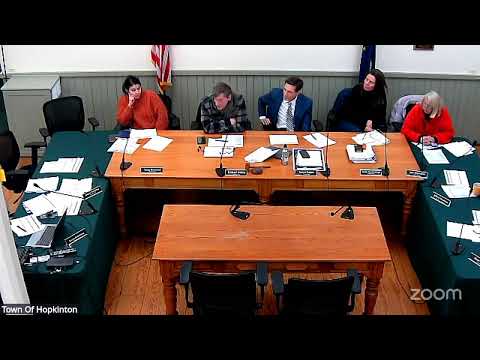
At the Jan. 20 work session, Hopkinton Planning Board members spent significant time discussing private roads, conservation-subdivision incentives and outdated road-construction standards.
Karen, the staff member supporting the Board, told members she believes the current ordinance does not provide sufficient incentives for developers to build conservation-style subdivisions; instead, developers are using conventional frontage rules to maximize lot counts. Karen cited a rough road construction cost estimate discussed in the meeting—"$750 a foot"—to illustrate why developers opt to avoid building additional road frontage that would require costly construction. She urged the Board to examine alternative incentives or ordinance language to better align outcomes with conservation goals.
The Board also discussed the possibility of allowing private roads under defined standards used by nearby communities. Members noted such an approach would require clear construction and maintenance standards, liability waivers, and a mandatory road-association or HOA to guarantee long-term maintenance and plowing. Karen and others stressed the Department of Public Works (Dan Blanchette) must be closely involved in drafting any private-road standards to address emergency access and future maintenance liability.
Karen reported DPW has recommended updates to road construction standards (for example, gravel depth and cul-de-sac sizing to allow plowing) and that subdivision bonding language is out of date (references to letters of credit). The Board agreed that these technical standards likely can be updated without town-meeting action but will need coordination with DPW and public hearings.
Members raised policy trade-offs: private roads may lower upfront developer costs but can reduce town control over maintenance and emergency access; HOAs can deter buyers through recurring fees. The Board asked staff to add private roads, road-construction standards, and class six road policy to the work plan for further review and to consult examples from other municipalities.
Next steps: Karen will research private-road and class six road policies from peer communities, coordinate with DPW on construction and bonding language, and return draft recommendations to the Planning Board for review.