Get Full Government Meeting Transcripts, Videos, & Alerts Forever!
Get email alerts on the Work Plan Zoning topic
No spam. Unsubscribe anytime.
Hopkinton Planning Board outlines 2026 work plan, prioritizes zoning and housing amendments
Summary
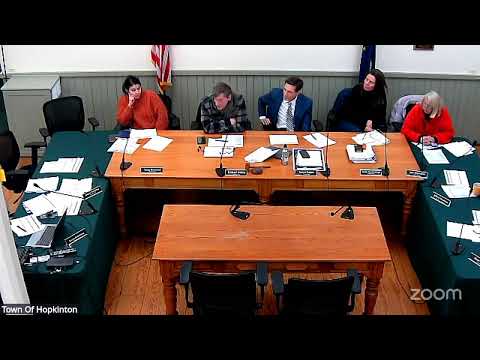
At a Jan. 20 work session, the Hopkinton Planning Board reviewed its 2026 work plan, directed staff coordination on a Natural Resources chapter with the Conservation Commission, and set internal deadlines for zoning amendments informed by the Housing Committee and the Barrett report.
At a Jan. 20, 2026 work session, the Hopkinton Planning Board reviewed a proposed 2026 work plan that centers on zoning updates and housing-related amendments. Karen, a staff member supporting the Board, told members she has contacted Ron Klamarzik, chair of the Conservation Commission, about whether the Conservation Commission or Regional Planning will draft the Natural Resources chapter and noted the Conservation Commission previously agreed to contribute toward the cost but the amount must be confirmed.
The Board agreed to pursue quarterly stakeholder outreach to track master-plan implementation and set an overall deadline of December 2026 for the chapters discussed. Karen said quarterly check-ins—beginning with outreach around April 15—would help the Board gather status updates and reported she will coordinate with relevant committees and regional planning staff.
Members reserved slots in the work plan for zoning amendments, noting placeholders do not imply a fixed number of proposals. Karen reviewed minutes from the Housing Committee and a table of uses from the Barrett report that together identify four zoning amendments the Housing Committee expects to forward; Dean indicated the Housing Committee will formalize those changes soon. Board members asked for a formal submission by March so the Planning Board can draft ordinance language in time for the next town meeting cycle.
Board members emphasized that the Housing Committee should offer rationale and prioritization rather than full ordinance drafts. As Karen put it, the Board intends to do the drafting work itself: "Ultimately, the decision is ours," she said, adding the Board will weigh whether recommended changes are substantive or merely language clarifications (for example, whether conversions to two-family dwellings are explicitly allowed or require special exception).
The Board also discussed whether the affordable housing chapter needs a rewrite or repeal-and-readopt process and flagged manufactured housing and the solar ordinance for comparatively small updates. Members suggested bringing in outside consultant help if the scope of drafting grows beyond internal capacity, but noted consultant work would require funding and clear scoping.
Next steps: Karen will follow up with the Housing Committee and Ron Klamarzik to confirm timelines and any pledged funding, and the Board expects to review formal Housing Committee input at its March meeting. No votes were taken on policy items during the work session.