Get Full Government Meeting Transcripts, Videos, & Alerts Forever!
Get email alerts on the Land Use Zoning topic
No spam. Unsubscribe anytime.
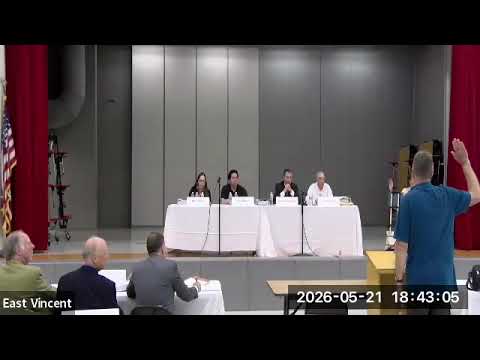
East Vincent supervisors deny Penhurst-area conditional‑use application for proposed data center
Summary
After hearing legal arguments over which zoning rules apply, the East Vincent Township Board of Supervisors voted to deny Penhurst Holdings DE LLC’s conditional‑use application for a large data‑center project at the former Pennhurst site, finding the plan did not meet the township’s general commercial standards and TDRs were not an available remedy.
The East Vincent Township Board of Supervisors voted to deny the conditional‑use application filed by Penhurst Holdings DE LLC for a proposed data‑center complex at the former Pennhurst State School and Hospital site after concluding the applicant’s plan did not comply with township zoning standards.
Chairman Brado opened the resumed hearing by limiting the proceedings to two threshold legal questions: which set of zoning criteria apply to the proposed planned commercial development, and whether the revised plan complies with those criteria. Counsel for the applicant, Matthew McHugh, argued the plan shows multiple principal uses — a data center plus on‑site power generation, battery storage and a customer substation — and asked the board to resolve apparent ordinance ambiguities in favor of the landowner so that IMU (industrial mixed‑use) or GI (general industrial) standards, rather than the GC (general commercial) standards, would control.
Opposing counsel Carl Ewald, representing East Vincent Advocacy, countered that the proposal is effectively a single hyperscale data center whose ancillary facilities are accessory to that primary use. Ewald told the board that, on its face, the plan does not meet the GC area and bulk standards and therefore should be denied at the threshold stage. Judith Gran, representing the Pennhurst Memorial Preservation Alliance, and Dr. James Conroy raised preservation and IMU design‑standard concerns for the Pennhurst campus, describing the former state school and hospital as a cultural resource that merits dedicated protection during land‑development review.
Board members and parties questioned whether transferable development rights (TDRs) could lawfully be used to meet area and bulk standards and whether required TDR documentation had been supplied; counsel for the applicant repeatedly replied that "the plan speaks for itself" and indicated the applicant could not demonstrate compliance with the GC provisions if those standards were applied.
After oral argument the chair moved that the board find the township’s GC provisions (Sections 27‑1103.2 and 27‑1104.2) apply to a planned commercial development in the IMU district; that IMU is not a receiving district for TDRs for such a development; and that the revised master conditional‑use plan before the board is not a planned commercial development and, even if it were, does not comply with the GC provisions. A supervisor seconded the motion; following public comment the motion carried and the conditional‑use application was denied.
Several East Vincent residents addressed the board during the public‑comment period. Longtime resident Jim Vaughn recounted local tax history and raised concerns about where data centers source power; Chris McNeel and other residents said they supported strict adherence to zoning. Attorney Judith Gran and others urged the board to preserve the cultural resources on the Pennhurst grounds and to ensure any future land development complies with IMU design requirements.
The chair said a next‑day letter would notify parties of the denial and that a full written decision would follow within 45 days, at which time the board will vote on adoption of that written determination. The board also directed parties to accept electronic service of post‑hearing documents where feasible.
Why it matters: The board’s threshold ruling establishes (for this application) that general commercial standards apply and that IMU is not a TDR receiving district for a planned commercial development; it removes the applicant’s immediate pathway to approval at this stage and sets the framing for any future filings or appeals.
What’s next: The official written decision will be drafted and circulated within 45 days. Parties may review that decision to determine whether to seek reconsideration or pursue further legal remedies.