Get Full Government Meeting Transcripts, Videos, & Alerts Forever!
Get email alerts on the Mobile Classrooms topic
No spam. Unsubscribe anytime.
Zebulon staff backs UDO change to allow mobile classrooms; commissioners press for time limits and stormwater safeguards
Summary
Zebulon staff recommended opening a public hearing on UDO text amendment 20-26 to allow mobile classrooms on existing school sites as a temporary use; Wake County Public School System requested the change and commissioners urged explicit timelines and attention to stormwater and design to prevent indefinite use.
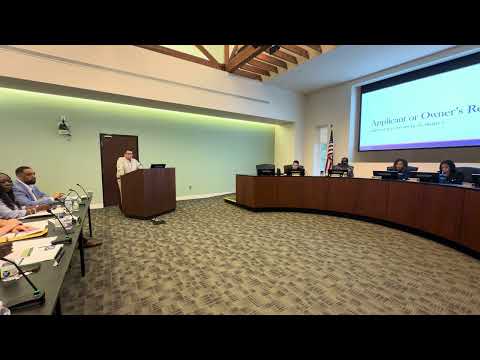
Planning staff presented a proposed Unified Development Ordinance (UDO) text amendment (20-26) initiated by Wake County Public School System to permit mobile classrooms as a temporary expansion of classroom space on existing school sites.
Ms. Barrow read the criteria the board should use to evaluate text amendments (citing sections including 2.2.2 and 20.21.G) and explained staff’s proposed language to add mobile classrooms to the temporary-use section (UDO 4.5.4) and to exempt temporary mobile classrooms from some commercial design standards under proposed edits to section 5.3.1.C.
The proposed wording would permit mobile classrooms on an existing school site "as a temporary expansion of classroom space until permanent classroom space is available" and requires that all applicable building, electrical, plumbing and mechanical permits be obtained prior to placement. Staff cited comparable approaches in Mooresville, Cary and Holly Springs and recommended opening the public hearing and referring the amendment to the planning board for consideration.
Commissioner Wheeler, speaking from personal experience, urged that the word "temporary" be paired with a concrete timeline (for example three or five years) and asked staff to ensure follow-up so mobile units do not become indefinite. Kelly raised similar points, warning that indefinite temporary authorizations could create a long-term cluster of units, and additionally cautioned about adding impervious surfaces that could worsen existing stormwater problems on some campuses.
Staff did not propose a fixed maximum duration in the read text; the board opened the public hearing with no in-person comments reported and referred the amendment to the planning board for consideration. The planning board will review the proposed text, consider whether to include explicit time limits, site design or stormwater standards, and return a recommendation to the Board of Commissioners.
Next steps: the planning board’s review will determine whether to retain the "until permanent classroom space is available" language or to recommend a defined temporary period, and whether to add site-specific design or stormwater mitigation conditions.