Get Full Government Meeting Transcripts, Videos, & Alerts Forever!
Get email alerts on the Land Conservation topic
No spam. Unsubscribe anytime.
Coastal Federation urges Beaufort to treat conservation as infrastructure and pursue strategic land purchases
Summary
Todd Miller of the Coastal Federation told the Beaufort Board on April 27 that land conservation should be treated as green infrastructure; he cited bond referenda and grants (including the North Carolina Land and Water Fund) and offered to partner with the town on property identification and acquisition.
Todd Miller of the Coastal Federation told the Beaufort Board of Commissioners that municipal land conservation is a form of infrastructure that can protect water quality, reduce flood risk and expand nature‑based recreation.
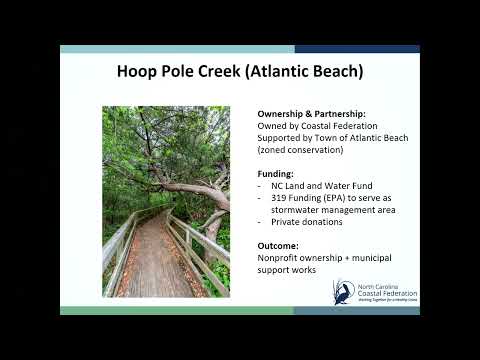
Miller presented examples of local projects funded through layered strategies — bonds, the North Carolina Land and Water Fund, federal grants and private donations — including the Cedar Point acquisition, Sugarloaf Island protection and other conservation purchases the federation has supported. "When you conserve land, you open up opportunities for nature‑based recreation," he said, arguing that preserved lands act as storm buffers, support water quality and add to community quality of life.
Board members pressed Miller on restoration versus purchase, funding timing, carbon‑credit possibilities and whether the Coastal Federation would be a local partner. Commissioners said recent community surveys show conservation is a high priority for residents, and several members urged a more strategic, intentional approach to identifying sensitive tracts and sequencing funding. Miller encouraged early property‑owner outreach and noted that willing sellers, appraisals and typical grant timelines (annual cycles) are critical to success.
The presentation highlighted that some programs have applicant‑type limits (for example, certain water‑access funds require a town, county or council of governments to apply) and that communities sometimes front money to secure property pending grant reimbursement. Commissioners indicated strong interest in following up; staff and the Coastal Federation agreed to continue conversations about potential projects and next steps.